
What are tension set diamond rings? They are rings where the diamond is held by the pressure of the band’s two ends pressing into grooves on the stone, so it seems to float. The setting alone usually costs $500 to $3,000 or more.
Last updated: November 2026 · Checked against published jewelry history and retailer listings
Key Takeaways
- The first tension ring, the Niessing Spannring, was made in 1979 by the German company Niessing (Wikipedia)
- A tension setting typically presses on the stone with about 12,000 psi, and some reach 50,000 psi
- Only stones of Mohs 9 or harder, such as diamond, sapphire, ruby and moissanite, are safe to tension set
- Tension rings are hard to resize: some designs allow up to two sizes, others must be remade
- A tension setting usually costs $500 to $3,000 or more before the diamond (Diamonds.pro)
- Many “tension-style” rings hide a small support under the stone, so ask which kind you are buying

Diamond Rings Info may earn a commission if you buy through links on this page, at no extra cost to you.
What is a tension set diamond ring?
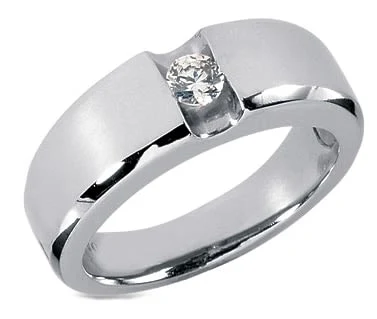
A tension set diamond ring holds the stone between the two open ends of the band, with no prongs or bezel. The band is made slightly springy, and small grooves cut into each end grip the diamond’s girdle, so the stone looks suspended in mid-air.
The name is a little misleading. As Wikipedia’s tension ring article explains, the stone is not held in tension (a pulling force) but in compression: the metal presses inward on it. Because so little metal touches the diamond, light enters from almost every side, which is why tension rings look so bright. You can see how they are made in this short video on tension set rings.
Who invented the tension setting?
The tension setting was developed in the late 1960s by Friedrich Becker, who worked for the German jeweler Niessing, and Niessing produced the first tension ring, the Spannring, in 1979. It was made of 18 karat gold and weighed 35 grams (Wikipedia).
In the United States, jeweler Steven Kretchmer developed a hardened platinum alloy for tension rings in 1987 and later received two patents for the tension-set ring. Today tension and tension-style rings are made by many jewelers in gold, platinum, titanium and steel.
How is a tension setting made?
The jeweler hardens the metal so it acts like a spring, cuts precise grooves into the ends of the band, opens the band slightly, and lets it close onto the diamond. Each setting is calibrated to its own stone, so the ring is made only after the diamond is chosen.
Wikipedia notes that tension settings generally exert around 12,000 pounds per square inch on the stone, and some up to 50,000 psi. That is why the metal must be strong and why tension rings are usually chunkier than ordinary setting styles, often using much more metal than a slim prong ring.
| Metal | Suitability for tension | Notes |
|---|---|---|
| Hardened platinum alloys | Excellent | Strong, white and durable; most expensive. See platinum diamond rings. |
| 18K and 14K gold | Good when work-hardened | The original Niessing ring was 18K gold |
| Titanium | Very good | Light and strong but very hard to resize; see titanium diamond rings |
| Stainless steel | Good | Mainly fashion rings |
Which stones can be tension set?
Only very hard stones can survive the pressure: diamond, sapphire, ruby and moissanite. As a rule, gems below 9 on the Mohs hardness scale are not suitable, and stones with large inclusions near the girdle may crack.
Because the diamond is so exposed, clarity and cut matter more than usual. Diamonds.pro recommends an eye-clean stone, around VS1 or better, since there are no prongs to hide edge inclusions. Colored options work well too; see our diamond and sapphire rings and ruby and diamond rings guides.
Are tension set diamond rings safe for everyday wear?
A well-made true tension ring is secure for daily wear, but a hard knock can still damage it, and the diamond’s exposed edge can chip. Wikipedia notes that tension settings do not lose their spring with age the way prongs wear down, but a blunt impact can dislodge the stone.
| Factor | Tension setting | Prong setting | Bezel setting |
|---|---|---|---|
| Light and sparkle | Excellent | Very good | Good |
| Stone protection | Fair; girdle exposed | Fair | Excellent |
| Snagging | Low | Can snag clothing | Very low |
| Resizing | Difficult or must be remade | Easy | Easy to moderate |
| Ring bulk | Heavy, wide band | Slim | Moderate |
Many rings sold as “tension style” have a hidden bar or partial bezel under the diamond for extra security. They look similar and are easier to resize, so they suit active wearers; ask the seller which type a ring is.
Can you resize a tension set ring?
Usually not easily. Resizing changes the spring that holds the stone, so some tension designs can only be resized by up to two sizes, and others must be melted down and remade around the diamond (Wikipedia).
Get sized carefully before you order, ideally at the end of the day, and use our ring size chart. If you expect your finger size to change, a tension-style ring with hidden support, or a regular setting, may be the wiser choice.
How much do tension set diamond rings cost?
The setting alone usually costs $500 to $3,000 or more, depending on metal and maker, and the diamond is priced separately. Platinum and designer tension rings cost the most.
| Tension setting (stone not included) | Metal | Listed price |
|---|---|---|
| Swirl solitaire setting | 14K white gold | $924 (Allurez) |
| Swirl solitaire setting | Platinum | $2,138 (Allurez) |
| Contoured twist tension setting | Platinum | $4,912 on sale (James Allen) |
Then add the diamond: a natural 1 carat round has a median price near $3,700 and a lab-grown one near $600; our loose diamonds and lab-grown diamonds guides explain the options.

Will tension ring prices change next year?
Tension setting prices follow metal prices and labor, so expect them to stay close to these ranges, with platinum and gold prices driving most changes. The diamond is usually the bigger cost, and lab-grown diamond prices keep falling. Check current listings before you buy.
Is a tension ring right for you?
Choose a tension ring if you love a modern, minimal look, want maximum sparkle and are happy to protect the ring from hard knocks. Choose a bezel or prong ring if you work with your hands, expect to resize, or want the most protection.
Tension rings are a striking unique ring. choice and are popular in men’s diamond wedding rings too, where the wide band suits the style. For classic alternatives, browse our Engagement Rings guide.
How this guide was researched: history, pressure figures, suitable stones and resizing facts come from Wikipedia’s tension ring article, buying advice from Diamonds.pro, and setting prices from current retailer listings.
Frequently asked questions about tension set diamond rings
How does a tension set ring hold the diamond?
The band is made springy and the diamond sits in small grooves cut into its two ends. The metal presses inward on the stone, typically at around 12,000 psi, holding it in place without prongs.
Are tension set diamond rings safe?
A well-made true tension ring is secure for daily wear, but a hard blow can damage the setting or chip the exposed edge of the diamond. Tension-style rings with hidden support are safer for active wearers.
Can a tension set ring be resized?
Usually only slightly. Some designs can be resized by up to two sizes, while others must be remade around the stone because resizing changes the spring that holds it.
How much does a tension set ring cost?
The setting alone usually costs $500 to $3,000 or more, depending on metal and maker. The diamond is extra, from around $600 for a lab-grown 1 carat to about $3,700 for a natural one.
Which stones can go in a tension setting?
Only very hard stones such as diamond, sapphire, ruby and moissanite. Gems softer than 9 on the Mohs scale can crack under the pressure.
Who invented the tension ring?
The idea was developed by Friedrich Becker at the German jeweler Niessing, which made the first tension ring, the Spannring, in 1979.
What is the difference between tension and tension-style rings?
A true tension ring holds the stone only by the pressure of the band. A tension-style ring looks similar but has a hidden bar or partial bezel supporting the diamond.
What metal is best for a tension ring?
Hardened platinum alloys and work-hardened gold are the most common. Titanium and stainless steel are strong and affordable but very hard to resize.
Ready to choose a tension ring?
Pick a hard, eye-clean diamond, choose platinum or hardened gold, confirm whether the ring is true tension or tension-style, get your size right first time, and buy from a jeweler who stands behind the setting. For more guides, visit Diamond Info.
Anthony Chege is a gem and jewelry dealer with 20 years’ experience sourcing, grading and selling diamonds, gemstones and gold. He writes for Diamond Rings Info on diamond grading, pricing and buying.
Diamond Info | Engagement Rings | Tension Set Rings