
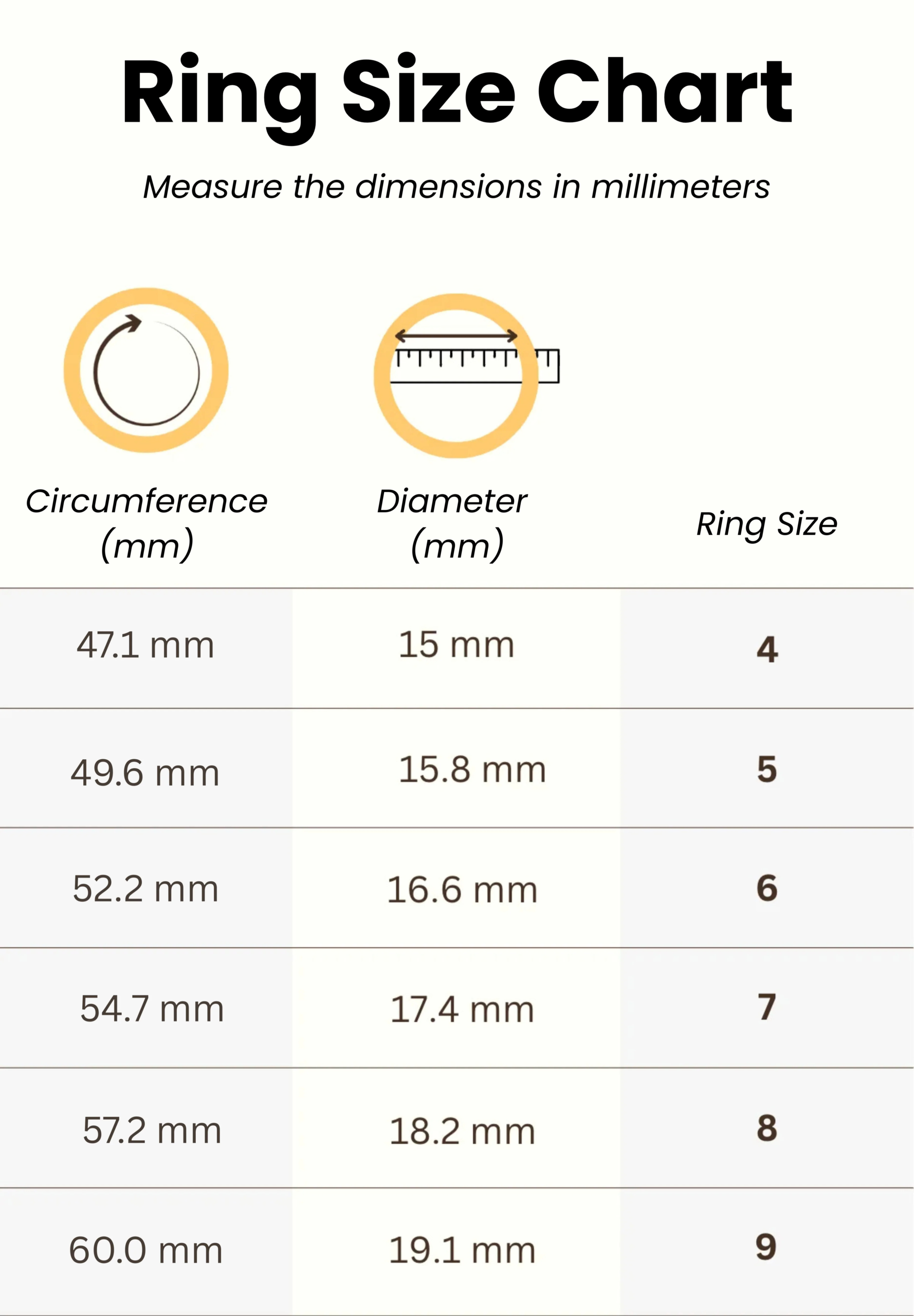
Quick answer: Ring sizes are measured by the internal circumference or diameter of the ring, and different countries use different numbering systems for the same physical size.
A US size 7 equals UK size N, EU size 54, and Japan size 14 — all describing a ring with roughly a 54.4mm inside circumference.
The most reliable way to find your size at home is to wrap a strip of paper or string around your finger, measure the circumference in millimeters, and match it against a standard sizing chart.
Buying a ring online means getting the size right without ever trying it on, and that gets more confusing the moment international sizing systems enter the picture.
This guide covers how ring sizing actually works, how to convert between systems, and how to measure your size accurately at home.
Full Ring Size Conversion Chart
| US / Canada | UK / Australia | EU | Japan | Diameter (mm) | Circumference (mm) |
|---|---|---|---|---|---|
| 4 | H | 47 | 7 | 14.8 | 46.5 |
| 4.5 | I | 48 | 8 | 15.2 | 47.8 |
| 5 | J | 49 | 9 | 15.7 | 49.3 |
| 5.5 | K | 50 | 10 | 16.0 | 50.3 |
| 6 | L | 52 | 12 | 16.5 | 51.9 |
| 6.5 | M | 53 | 13 | 16.9 | 53.1 |
| 7 | N | 54 | 14 | 17.3 | 54.4 |
| 7.5 | O | 56 | 15 | 17.7 | 55.7 |
| 8 | P | 57 | 16 | 18.1 | 56.9 |
| 8.5 | Q | 58 | 17 | 18.5 | 58.1 |
| 9 | R | 59 | 18 | 18.9 | 59.5 |
| 9.5 | S | 61 | 19 | 19.3 | 60.7 |
| 10 | T | 62 | 20 | 19.8 | 62.1 |
| 10.5 | U | 63 | 21 | 20.2 | 63.5 |
| 11 | V | 65 | 22 | 20.6 | 64.6 |
| 11.5 | W | 66 | 23 | 21.0 | 66.0 |
| 12 | X | 67 | 24 | 21.4 | 67.2 |
This chart reflects standard published sizing references. Sizing can vary slightly by jeweler and band width, so confirm with an in-person or professional sizing tool for an important purchase. For half-sizes and the full range from size 3 to 13, use our interactive ring size convertor.
Ring Size Chart & Converter
Convert between sizing systems, or find your size from a measurement you already have.
How to Measure Your Ring Size at Home
- Wrap a strip of paper or string snugly around the base of the finger you’ll wear the ring on.
- Mark where the paper or string overlaps to complete the circle.
- Lay it flat and measure the length in millimeters — that’s your circumference.
- Enter that number under “Find From Measurement” above to get your size across all systems.
- Measure at the end of the day when fingers are largest, and avoid measuring when cold, since fingers shrink slightly in the cold.
This chart reflects standard published sizing references and is intended as a starting point. Ring sizes can vary slightly between jewelers and band widths, so for an important purchase, confirming with an in-person or professional sizing tool is recommended.
What Determines Ring Size?
A ring’s size is determined by the inside circumference or diameter of the band, measured in millimeters.
Every major sizing system — US, UK, EU, and Japan — measures the same underlying physical dimension; they just express it with different numbering conventions.
The US and Japan use ascending numeric scales, the UK and Australia use letters (A through Z and beyond), and the EU uses the circumference measurement itself, rounded to the nearest whole millimeter.
How to Measure Your Ring Size at Home
- Cut a thin strip of paper or a piece of string about 6 inches (15 cm) long.
- Wrap it snugly around the base of the finger you’ll wear the ring on — snug enough to stay in place, but not so tight it pinches.
- Mark the point where the strip overlaps to complete a full circle.
- Lay the strip flat and measure the length from the start to the mark in millimeters. This number is your circumference.
- Match that circumference against the conversion chart above to find your size in any system.
- Measure at the end of the day, when fingers are at their largest, and avoid measuring when your hands are cold, since fingers temporarily shrink in cold temperatures.
If you already own a ring that fits the intended finger well, you can measure its inside diameter instead: lay it flat and measure straight across the inner edge in millimeters, then match that to the diameter column in the chart.
Ring Size Chart by Country: What Each System Means
What Is a US Ring Size?
US ring sizes (shared with Canada) use a numeric scale, typically from about 3 to 13 for adults, increasing in half-size increments. Each half-size step corresponds to roughly 0.4mm of circumference. This is the most common sizing reference used by US-based online jewelers.
What Is a UK Ring Size?
UK ring sizes (also used in Australia, Ireland, and New Zealand) use a letter-based scale, running from A (smallest) through Z and beyond for larger sizes, with half-sizes noted with a ½ suffix. A UK size is based on the same circumference measurement as other systems, just mapped to letters instead of numbers.
What Is an EU Ring Size?
EU ring sizes are the most direct of all the systems: the size number is simply the inside circumference of the ring in millimeters, rounded to the nearest whole number. A EU size 54 ring has a circumference of approximately 54mm.
What Is a Japan Ring Size?
Japan ring sizes use a numeric scale similar to the US system but with different increments, typically running from about 1 to 27 for adult sizes. Japan sizes are also commonly used as a reference point across other parts of Asia.
Common Ring Sizing Questions
Does Ring Width Affect Sizing?
Yes. Wider bands (generally anything above 6mm) tend to fit more snugly than thinner bands of the same labeled size, because more surface area contacts the finger. Many jewelers recommend going up half a size for wide bands to maintain the same comfort level as a standard-width ring.
Do Ring Sizes Differ Between Left and Right Hands?
For most people, yes, slightly. Since most people’s dominant hand is marginally larger due to greater muscle development, it’s worth measuring the specific finger you intend to wear the ring on rather than assuming both hands match.
Can Fingers Change Size Over Time?
Yes. Fingers can change size due to temperature, time of day, weight fluctuations, pregnancy, and age. If you’re buying a ring for permanent daily wear, measuring at a few different times and averaging the results gives a more reliable size than a single measurement.
Ring Size Chart FAQ
How do I find my ring size without a sizing tool? Wrap a strip of paper or string around the base of your finger, mark where it overlaps, measure the length in millimeters, and match that circumference to a standard sizing chart.
What is the average ring size for women? In the US sizing system, the average ring size for women is typically between 6 and 7, though this varies by individual.
What is the average ring size for men? In the US sizing system, the average ring size for men is typically between 9 and 11, though this varies by individual.
Is a EU size 54 the same as a US size 7? Yes, approximately. A EU size 54 corresponds to a circumference of about 54mm, which matches a US size 7 (54.4mm circumference) closely enough to be considered the same practical size.
Should I round up or down if my measurement falls between two sizes? When in doubt, size up rather than down. A slightly loose ring is a minor inconvenience that can often be resized down; a ring that’s too tight may not go on at all or could require cutting off in an emergency.