
Quick answer: A diamond value calculator estimates a diamond’s market worth using its carat weight, color grade, clarity grade, and cut grade, the same “4 Cs” a jeweler or appraiser uses, run through pricing data for stones with similar specifications.
It gives a useful starting-point range, not a final number. For an exact figure tied to a specific stone, an independent certified appraisal is still the only reliable source.
Whether you’re buying an engagement ring, selling an old piece of jewelry, or just curious what a diamond you already own might be worth, the honest answer is: it depends on more variables than most people realize. A diamond value calculator exists to make sense of those variables quickly, without needing to be a gemologist yourself.
What Is a Diamond Value Calculator?
A diamond value calculator is a tool that takes a diamond’s key specifications and returns an estimated market value based on how similar diamonds are typically priced. Instead of guessing, or relying entirely on whatever number a single jeweler quotes, it gives you a transparent, repeatable way to sanity-check a price using the same grading factors the industry itself relies on.
Try our free Diamond Value Calculator to get an estimate for your own diamond’s specifications, including a full breakdown of how each grade affects the final number.
Diamond Value Calculator
Enter a diamond’s specifications below for an educational estimate of its market value.
Cut grade applies to round brilliants under GIA/AGS standards; fancy shapes are judged more subjectively.
This is an educational estimate, not a formal appraisal. Actual prices vary by retailer, certifying lab, fluorescence, symmetry, polish, market conditions, and individual stone characteristics a calculator can’t see. For insurance, resale, or purchase decisions, consult a certified independent appraiser.
Use A Diamond Price Calculator To Plan Your Budget
It is a useful tool to have as even having a ball park price for a diamond is better than going shopping without any idea whatsoever.
Look at it as providing an average price range for the diamond you are looking for.
Below are the parameters used to determine diamond prices internationally
Carat Weight
Carat measures a diamond’s weight, not its size, and it’s the factor most people already know about.
Diamond carat weight is the measurement of how much a diamond weighs. A metric carat is defined as 200 milligrams.
A carat can be subdivided into 100 points. This allows measurements to a hundred decimal place. A 0.75 carat diamond can be described as a seventy-five pointer.
Diamonds that weigh more than 100 points are expressed in carats as 100 points = 1 carat.
Price doesn’t scale in a straight line with carat weight; diamonds get disproportionately more expensive at certain benchmark sizes (1 carat, 2 carats, 3 carats) because demand jumps sharply at those “magic sizes,” even though the physical size difference from, say, 0.95 to 1.00 carats is barely noticeable.
Diamond Color
The color of a diamond refers to its degree of yellowness. The ideal diamond is completely colorless, and therefore it will be the most expensive.
Many systems have been used to grade diamond color alphabetically from D (totally colorless) to Z (yellow) .
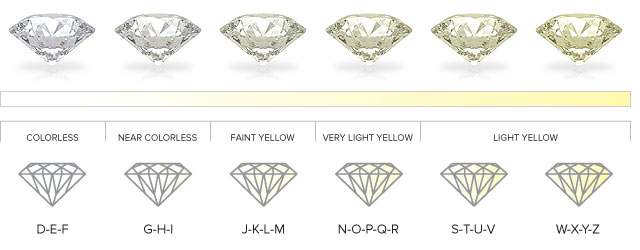
- D (Colorless) – Highest color grade your diamond can achieve. This color emits unequaled brilliance, and is highly sought after thus most expensive.
- E (Colorless) “ Containing minute traces of color. Emits unsurpassed brilliance, and is quite rare but slightly cheaper that the D color above.
- F (Colorless) “ Minute traces of color can only be detected by a trained gemologist. This is a high-quality color grade & still on the costly scale.
- G, H (Near Colorless) “ Noticeable color only when compared to higher color grades. Excellent value, as it appears colorless to the untrained eye. This grade is more affordable as its more common than the top three D, E and F
- I, J (Near Colorless) – Slightly detectable color. Excellent value, as it appears colorless to the eye. At this color grade, you can get some very good deals without seeming to cut corners. Diamonds at this color grade seem white to the naked eye.
- K, L, M (Faint Yellow) – Faint color noticeable to the naked eye. Even with the presence of color, diamonds can emit fire & are beautiful especially when well cut.
Diamond Clarity
Clarity is a measure of the number and extent of the flaws in the diamond.
Generally speaking, the fewer the flaws, the more valuable the diamond.
Clarity can also refer to the presence of identifying marks on & within the diamond.
Diamond clarity is obtained using 10X or a ten power magnification as most inclusions are invisible or not easily visible to the naked eye.
Diamond Cut
There are eight common diamond cuts or shapes that are offered by fine jewelers: These are Round diamonds
Heart shaped diamonds, Oval diamonds, Princess cut diamonds, Pear shaped diamonds, Emerald cut diamonds, Marquise cut diamonds and asscher cut diamonds.
Historically, the most popular diamond shape has been the round or brilliant cut diamond shape.
This is due to is amazing symmetry that causes the most amount of fire to be displayed in the diamond.
Shape
Round brilliant diamonds command the highest price per carat of any shape, because the cutting process wastes more of the rough stone to achieve that shape’s precise proportions. Fancy shapes like princess, cushion, oval, and emerald typically cost 10-20% less per carat for a visually comparable stone.
Natural vs. Lab-Grown
Lab-grown diamonds are chemically and optically identical to natural diamonds, but they’re currently priced dramatically lower, often 85-90% less than a natural diamond of the same specifications, due to differences in supply and market perception rather than any difference in physical quality.
Any value calculator should let you specify natural or lab-grown separately, since using the wrong one will give a wildly inaccurate estimate.
How to Use a Diamond Value Calculator
- Gather your diamond’s specifications: carat weight, color grade, clarity grade, cut grade, and shape. These are usually listed on a grading certificate (GIA, IGI, or AGS) if the diamond has one.
- Specify whether the diamond is natural or lab-grown, since this changes the estimate significantly.
- Enter the values into the calculator and review the estimated value range, not just a single number, since real market prices vary by retailer and market conditions.
- Compare the breakdown of how each factor (color, clarity, cut, shape) contributed to the estimate, to understand which grade is driving the price most.
- Use the estimate as a starting point for negotiation or comparison shopping, not as a final appraisal figure.
What a Value Calculator Can’t Tell You
A calculator works from typical pricing patterns across many diamonds with similar specifications; it can’t see the actual stone in front of you. It won’t account for:
- Fluorescence — how a diamond reacts under UV light, which can affect both appearance and price
- Symmetry and polish — finer-grained quality factors beyond the basic cut grade
- Certification lab — a diamond graded by a stricter lab (like GIA) may be worth more than one with the same stated grade from a less conservative lab
- Market timing — diamond prices fluctuate with broader market conditions, particularly for lab-grown stones, whose prices have been falling rapidly
- The individual stone’s specific inclusions or characteristics — two diamonds with the same certificate grade can still look different in person
For a real transaction — buying, selling, or insuring a diamond — a certified independent appraisal remains the only way to get a number that accounts for the specific stone in front of you.
Diamond Value Calculator FAQ
How accurate are online diamond value calculators? They’re accurate as a general estimate based on typical market pricing for diamonds with similar specifications, typically within 15-20% of real market value. They can’t replace an in-person appraisal of your specific stone.
What information do I need to use a diamond value calculator? At minimum, you need carat weight, color grade, clarity grade, and cut grade. Shape and whether the diamond is natural or lab-grown also significantly affect the estimate.
Are lab-grown diamonds worth less than natural diamonds? Yes, currently lab-grown diamonds sell for a fraction of the price of natural diamonds with the same specifications, despite being chemically identical, due to supply differences and market perception rather than physical quality differences.
Why did my jeweler quote a different price than the calculator? Retail prices include markup, brand premium, and setting/labor costs beyond the raw diamond’s estimated value, and individual stones vary in ways a calculator can’t see (fluorescence, symmetry, specific inclusion placement). A calculator estimate and a retail quote are answering slightly different questions.
Does a diamond’s certificate affect its value? Yes. A grading certificate from a well-respected lab like GIA provides third-party verification of the diamond’s specifications, which affects buyer confidence and resale value even when comparing diamonds with identical stated grades from different labs.