
What should you know about ruby and diamond rings? Ruby is red corundum, rated 9 on the Mohs scale, so it pairs well with diamond for daily wear. Color drives value, most rubies are heated, and a heated 1 carat ruby usually starts around $1,000 per carat.
Last updated: November 2026 · Checked against GIA guidance, auction records and dealer price lists
Key Takeaways
- Ruby is the red variety of corundum, colored by chromium, with a Mohs hardness of 9 (GIA)
- GIA says color is the most significant factor in a ruby’s value (GIA)
- Almost all rubies are treated in some way, most often with heat; lead-glass filling is a cheaper treatment to watch for (Wikipedia)
- At 1 carat, an unheated ruby costs around 3 times as much as a heated one (The Natural Ruby Company)
- The 25.59 carat Sunrise Ruby sold for $1,266,901 per carat, and the Estrela de Fura later fetched $34.8 million
- Ruby is the July birthstone and the gem for the 15th and 40th anniversaries

Diamond Rings Info may earn a commission if you buy through links on this page, at no extra cost to you.
What is a ruby?
A ruby is the red variety of the mineral corundum, the same species as sapphire. Pure corundum is colorless; traces of chromium give ruby its red, and the name comes from ruber, Latin for red (Wikipedia).
Ruby rates 9 on the mohs scale, second only to diamond’s 10, which is why a ruby set with diamonds can be worn every day. GIA notes that rubies can command the highest per-carat price of any colored stone. Watch this short video on ruby to see how the color changes in different light.
What does a ruby and diamond ring symbolize?
A ruby and diamond ring stands for passion, love and lasting commitment: the red of the ruby for passion and the diamond for permanence. Ruby is the traditional birthstone for July and the gem for the 15th and 40th wedding anniversaries, which makes these rings popular anniversary gifts (GIA).
They are also a classic alternative to an all-diamond diamond ring. For other ways to add color, compare a pink sapphire and diamond ring or browse our birthstone rings.
How do you judge ruby quality?
Judge a ruby by color first, then transparency, then size. GIA says color is the most significant factor in value, and the finest rubies are a strong, pure red that is neither too dark nor too light (GIA).
| Factor | What to look for | Effect on price |
|---|---|---|
| Color | Vivid, pure red; the trade calls the best “pigeon’s blood” | The biggest driver |
| Clarity | Some inclusions are normal; avoid any that reduce brightness | Obvious inclusions lower value dramatically |
| Treatment | Heated is standard; unheated is rarer; glass-filled is cheapest | Unheated about 3x heated at 1 ct |
| Origin | Myanmar (Mogok) has the top reputation; Mozambique is the biggest source | Burmese stones often fetch a premium |
| Size | Fine rubies over 3 carats are rare | Price per carat rises steeply |
Inclusions are expected: GIA notes that inclusion-free rubies are practically nonexistent. What matters is whether they cut down the stone’s brightness when you look at it face up.
Are most rubies treated?
Yes. Almost all rubies are treated in some form, and heating is the most common and widely accepted treatment because it improves color and clarity permanently (Wikipedia). A heated ruby is still a natural ruby, but it should be disclosed and priced accordingly.
Lead-glass filling is a different matter. It fills fractures in low-grade stones with glass, which makes them look far better than they are, but the glass can be damaged by heat, chemicals and jewelry repairs. Synthetic rubies are also common and cheap; Auguste Verneuil announced commercial flame-fusion rubies in 1903. Ask for a lab report that states treatment and origin, and see our fake rings guide for imitation warning signs.
How much do ruby and diamond rings cost?
The ruby usually sets the price. A heated natural ruby around 1 carat typically costs at least $1,000 per carat, an unheated one around three times as much, and a lab-created ruby a small fraction of either. Diamonds and the metal then add to the total.
| Ruby tier (around 1 carat) | Typical price per carat | Example |
|---|---|---|
| Lab-created | A small fraction of natural | Cheaper than a basic setting |
| Heated, commercial to good | About $1,000 to $4,000 | 1.11 ct heated Myanmar ruby at $3,885/ct |
| Unheated, fine | About 3x heated | 1.06 ct untreated Mozambique ruby at $9,775/ct |
| Unheated Mogok, top color | About $12,000 to $30,000+ | Private-market range for 1 to 2 ct stones |
The figures come from The Natural Ruby Company’s pricing guide and listings and a dealer’s report on unheated Burma ruby prices. A useful rule of thumb from the same retailer is that the setting rarely costs more than the ruby, though adding accent diamonds makes the price jump.
At the very top, prices are extraordinary. GIA reports that the 25.59 carat Sunrise Ruby sold for $1,266,901 per carat, and the Estrela de Fura later sold for $34.8 million, a record for a ruby at auction.

Will ruby prices change next year?
Fine ruby prices tend to hold or rise slowly because top stones are scarce, so the tiers above should stay a reliable guide. Mozambique’s Montepuez mine, which reportedly produced about 10 million carats in a single year, keeps commercial-grade supply steady. Lab-created rubies remain cheap. Check current listings before buying a valuable stone.
Which settings suit ruby and diamond rings?
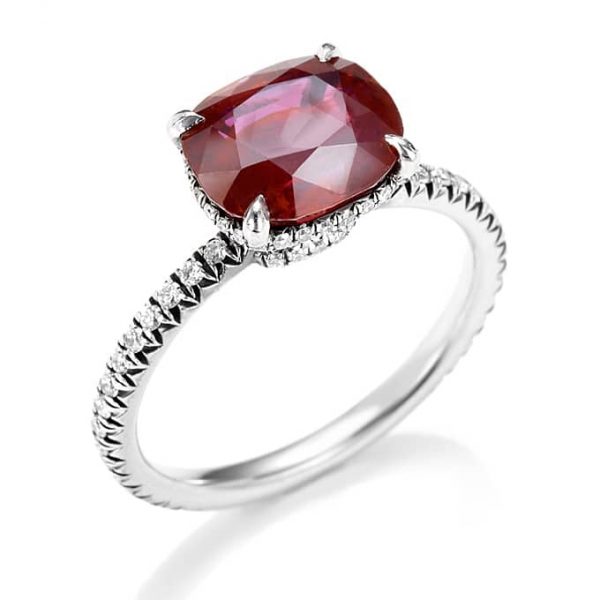
The most popular designs are a ruby center with a diamond halo, a three-stone ring with a ruby flanked by diamonds, and a ruby band set with alternating diamonds. Each balances the red with white sparkle.
- Halo: diamonds around an oval or cushion ruby make it look bigger and brighter.
- Three-stone: a classic anniversary design; compare our oval and heart shaped guides for center shapes.
- Cocktail: a large ruby surrounded by diamonds; see diamond cocktail rings.
Yellow gold warms the red, as our yellow gold engagement rings guide shows, while platinum or white gold gives sharper contrast. For one-of-a-kind designs, see our Unique Rings guide.
How do you buy and care for a ruby and diamond ring?
Buy from a seller who discloses treatment and gives a lab report for any valuable ruby, then compare color in daylight and indoor light. Ask directly whether the ruby is heated, unheated, glass-filled or lab-created.
Clean the ring with warm soapy water and a soft brush. Heated and unheated rubies are durable, but keep glass-filled rubies away from ultrasonic cleaners, steam and jeweler’s torches. Online jewelers such as James Allen offer gemstone and diamond settings if you’d like to design your own, and our diamond engagement rings guide covers the diamond side in depth.
How this guide was researched: gem facts and quality factors come from GIA, treatments and history from Wikipedia, and prices from The Natural Ruby Company’s guide and listings and a dealer’s market report on unheated Burma rubies.
Frequently asked questions about ruby and diamond rings
Is a ruby and diamond ring good for everyday wear?
Yes. Ruby is 9 on the Mohs scale, second only to diamond, so a ruby and diamond ring stands up well to daily wear. Glass-filled rubies are the exception and need gentle care.
How much does a ruby and diamond ring cost?
It depends mostly on the ruby. A heated natural ruby around 1 carat usually costs at least $1,000 per carat, unheated stones about three times more, and lab-created rubies far less.
What color ruby is the most valuable?
A vivid, pure, strong red that is neither too dark nor too light. The trade calls the best color pigeon’s blood, and it commands a large premium.
Are most rubies heat treated?
Yes. Almost all rubies are treated, most often with heat, which permanently improves color and clarity. Unheated rubies are rarer and cost more.
What is a glass-filled ruby?
It is a low-grade ruby whose fractures are filled with lead glass to improve its look. It is far cheaper and less durable, and should always be disclosed.
What does a ruby and diamond ring mean?
It symbolizes passion and lasting love. Ruby is the July birthstone and the traditional gem for the 15th and 40th anniversaries.
Which metal suits a ruby and diamond ring?
Yellow gold warms the red and gives a classic look, while platinum or white gold creates sharper contrast with the diamonds.
Where do the best rubies come from?
Myanmar’s Mogok Valley has the most famous rubies, while Mozambique’s Montepuez mine is now the largest source of gem-quality ruby.
Ready to choose your ruby ring?
Put color first, ask whether the ruby is heated, unheated, glass-filled or lab-created, insist on a report for valuable stones, and choose a halo or three-stone setting with diamonds to frame the red. For more guides, visit Diamond Info.
Anthony Chege is a gem and jewelry dealer with 20 years’ experience sourcing, grading and selling diamonds, rubies, sapphires and other gemstones. He writes for Diamond Rings Info on gem grading, pricing and buying.
Diamond Info | Unique Rings | Ruby Rings