
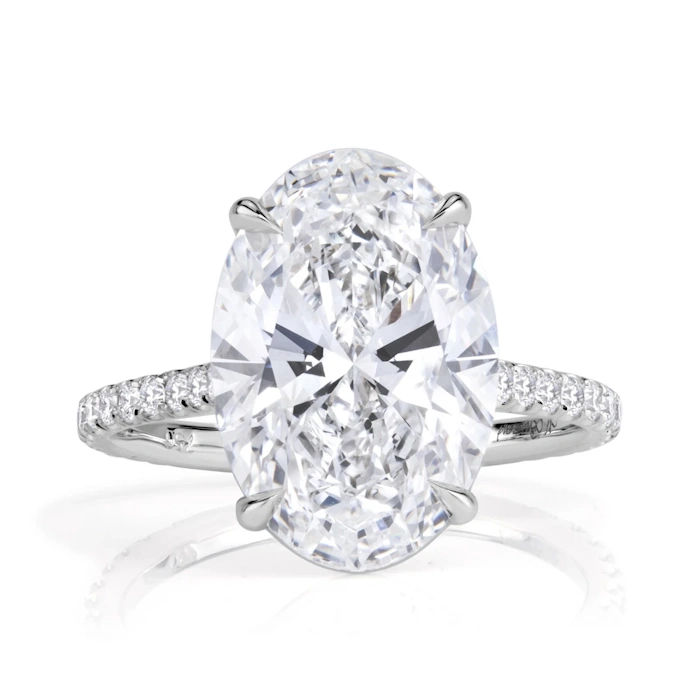
What are oval engagement rings? Oval engagement rings feature an elongated, egg-shaped brilliant-cut diamond that looks larger than a round of the same carat weight and slims the finger. Ovals were chosen for 25% of 2025 engagement rings, close behind round.
Last updated: October 2026 · Checked against GIA guidance and The Knot’s 2025 data
Key Takeaways
- Ovals were 25% of 2025 engagement rings, just behind round at 26%, in The Knot’s survey of 10,000+ couples (Rapaport)
- The modern oval brilliant was developed in 1957 by cutter Lazare Kaplan (GIA)
- A length-to-width ratio of 1.40–1.50:1 is the classic, most popular oval; above 1.50 the bow-tie usually gets stronger
- Every oval shows some bow-tie, a dark shadow across the center; a well-cut stone keeps it subtle
- GIA gives no overall cut grade for ovals, so check for Excellent or Very Good polish and symmetry (GIA)
- Oval was the most popular shape for lab-grown center stones in 2025, which averaged 2 carats

What are oval engagement rings?
Oval engagement rings are set with an oval brilliant diamond, a symmetrical elongated shape with smooth curves and no corners. Like a round brilliant, a typical oval has 57 or 58 facets designed for maximum sparkle (GIA). GIA notes that cut quality is what “fuels a diamond’s fire, sparkle and brilliance,” which matters even more in a fancy shape (GIA 4Cs).
Elongated diamonds have existed since the 1700s, but the modern oval brilliant was developed in 1957 by diamond cutter Lazare Kaplan. The shape has surged recently: GIA notes ovals made up 23% of engagement rings in The Knot’s 2023 data, and by 2025 they reached 25% (Rapaport).

Why are oval engagement rings so popular?
Ovals combine round-like sparkle with a larger look and a more distinctive outline. Their elongated shape spreads the same weight over more surface area, so an oval looks bigger than a round diamond of the same carat weight and makes the finger appear longer and slimmer.

In our experience, ovals also tend to cost less per carat than rounds of similar quality, because more of the rough crystal is kept when cutting. Lab-grown buyers love the shape: oval was the top shape for lab-grown center stones in 2025, which averaged 2 carats (Rapaport). Compare stone types in our lab created vs real diamonds guide.
What is the best length-to-width ratio for an oval?
A ratio of 1.40 to 1.50 gives the classic oval look and is the most popular range. Ratios of 1.30 to 1.40 look softer and rounder, while anything above 1.50 looks long and slender but usually shows a stronger bow-tie (GIA).

| Ratio | Look | Bow-tie risk | Best for |
|---|---|---|---|
| 1.20–1.29:1 | Short, almost cushion-like | Low | Buyers who want a near-round look |
| 1.30–1.40:1 | Soft, rounded oval | Low to moderate | Shorter fingers and halo settings |
| 1.40–1.50:1 | Classic oval | Moderate | Most buyers; the popular sweet spot |
| 1.50–1.60:1 | Long and slender | Higher | Long fingers and a dramatic look |
Also check the shoulders, the curves at each end. GIA warns to “watch out for flat or bulging shoulders, which can make the oval look like a rounded marquise or too pill-shaped.”
What is the bow-tie effect in oval diamonds?
The bow-tie is a dark, bow-shaped shadow across the center of an oval, caused when your head blocks light from reaching some facets. Every oval shows one to some degree; the goal is a subtle bow-tie, not none at all (GIA).

Because GIA does not give fancy shapes an overall cut grade, judge the bow-tie by eye or from a video, and look for Excellent or Very Good polish and symmetry on the report (GIA). Our diamond cut guide explains these finish grades.
Which setting suits an oval engagement ring best?
A solitaire shows the oval’s outline most cleanly, a halo adds size and sparkle, side stones add presence, and an east-west setting turns the oval sideways for a modern twist. Use prongs at the tips to protect the oval’s narrow ends.

GIA suggests keeping side stones within one to two color grades of the center stone. A three-stone diamond ring with pear or half-moon sides frames an oval beautifully; see more options in our diamond ring settings guide.
For metal, yellow gold is having a big moment and flatters slightly warmer stones, while platinum and white gold keep colorless ovals icy. Compare them in our gold diamond engagement rings and platinum diamond rings guides.
What color and clarity should an oval diamond be?
Aim for G to H color and VS2 to SI1 clarity for the best value. Ovals can show more color at their tips than rounds, so G–H keeps the stone bright, while J can work well in yellow or rose gold (GIA).
See our diamond color chart and diamond clarity chart for every grade, and always buy with an independent report; our diamond certificate guide shows what to check, and you can verify a GIA report online with GIA Report Check.
How much do oval engagement rings cost?
Most couples spend a few thousand dollars. In 2025 the average engagement ring cost $4,600; lab-grown rings averaged $4,300 for a 2-carat stone, where oval was the top shape, and natural rings averaged $7,000 for 1.6 carats (Rapaport).
Because an oval usually costs less per carat than a comparable round, it is one of the best shapes for maximizing visible size. Our diamond carat guide shows how weight relates to size, and our pear-shaped diamond rings guide covers another elongated favorite.
How we researched this guide
This guide draws on Anthony Chege’s 20 years of cutting, grading and setting fancy-shape diamonds, checked against GIA’s oval diamond and fancy-shape buying guides and The Knot’s 2025 study of more than 10,000 couples. Prices are averages and vary widely with the 4Cs and metal.
Frequently asked questions about oval engagement rings
Are oval engagement rings popular?
Yes. Ovals were 25% of engagement rings in 2025, just behind round at 26%, in The Knot's survey of more than 10,000 couples, and they were the top shape for lab-grown center stones.
Do oval diamonds look bigger than round diamonds?
Yes. An oval spreads its weight over a longer outline, so it covers more surface area than a round diamond of the same carat weight and also makes the finger look longer.
What is the best ratio for an oval diamond?
A length-to-width ratio of 1.40 to 1.50 gives the classic oval look and is the most popular range. Choose 1.30 to 1.40 for a softer, rounder oval, or above 1.50 for a long, slender stone.
What is the bow-tie in an oval diamond?
It is a dark, bow-shaped shadow across the center of the stone, caused by your head blocking light. All ovals show some bow-tie; a well-cut oval keeps it faint.
Are oval diamonds cheaper than round diamonds?
Usually, yes. Ovals tend to cost less per carat than round diamonds of similar quality because more of the rough crystal is kept during cutting.
What color and clarity are best for an oval engagement ring?
G to H color and VS2 to SI1 clarity offer the best value. Ovals can show color at the tips, so go higher in color for platinum or white gold, or as low as J in yellow gold.
Which setting is best for an oval diamond?
A four- or six-prong solitaire shows off the shape, a halo makes it look larger, and three-stone or east-west settings add a distinctive touch. Prongs at the tips protect the narrow ends.
Does GIA give oval diamonds a cut grade?
No. GIA does not give fancy shapes such as ovals an overall cut grade, so look for Excellent or Very Good polish and symmetry and judge the bow-tie and outline by eye.
Found your oval?
Check the ratio, the bow-tie and the report, then plan a matching band with our diamond wedding ring sets guide.
Anthony Chege is a gem and jewelry dealer with 20 years’ experience sourcing, grading, setting and selling diamonds and engagement rings. He writes for Diamond Rings Info on diamond grading, pricing and buying.