
How do you choose gold diamond engagement rings? Pick the gold color that flatters the diamond and your skin, then choose 14K for toughness or 18K for richer color. A simple 14K setting with a natural 1 carat diamond usually costs about $4,200 to $6,000.
Last updated: November 2026 · Checked against metallurgy references, survey data and current prices
Key Takeaways
- Karats measure gold in parts per 24: 10K is 41.7% gold, 14K 58.3%, 18K 75% and 22K about 91.7% (Wikipedia)
- 18K rose gold is typically 75% gold, 22.25% copper and 2.75% silver (Wikipedia)
- Yellow gold is the most popular engagement ring metal, chosen by 39% of couples in The Knot’s latest study (Rapaport)
- Gold is the most malleable metal: one gram can be beaten into a sheet of about one square meter (Wikipedia)
- A natural 1 carat round diamond has a median price of $3,710, and a lab-grown one $606 (CaratRadar)
- White gold needs rhodium replating every few years; yellow and rose gold only need polishing

Diamond Rings Info may earn a commission if you buy through links on this page, at no extra cost to you.
Why is gold used for diamond engagement rings?
Gold is warm, durable when alloyed, easy for jewelers to work, and less costly than platinum, which makes it the most common metal for diamond rings. It also never tarnishes, so a gold band keeps its color for generations.
People have prized Gold for thousands of years. The oldest known gold artifacts, from Bulgaria, date to the 5th millennium BC, and around 1350 BC King Tushratta of Mitanni wrote to the pharaoh that “gold is as plentiful as dust” in Egypt, in one of the Amarna letters (Wikipedia).
Gold’s working qualities matter just as much. It is the most malleable metal, so a jeweler can shape fine prongs and detailed galleries, and it alloys easily with other metals to make it harder or change its color.

Which gold color suits a diamond engagement ring?
Choose yellow gold for a warm, classic look, white gold for a bright modern look that makes a colorless diamond appear icier, and rose gold for a soft, romantic pink. All three hold diamonds equally securely.
| Gold color | What it is mixed with | Best with | Upkeep |
|---|---|---|---|
| Yellow gold | Silver and copper; standard 18K is 75% gold, 12.5% silver, 12.5% copper | Near-colorless diamonds (G to J), vintage styles | Polish only |
| White gold | Nickel or palladium, usually rhodium plated | Colorless diamonds (D to G), modern styles | Rhodium replating every few years |
| Rose gold | Mostly copper, a little silver | Warmer diamonds, pink and champagne stones | Polish only |
Yellow gold flatters a slightly warm diamond, which means you can often save by choosing an H to J color; our guide to the diamond white color scale explains the grades. For a full guide to the warm option, see yellow gold engagement rings.
White gold is gold alloyed with white metals and usually plated with rhodium for a bright finish. Nickel alloys can cause skin allergies in some people, so ask for palladium white gold or consider platinum if you are sensitive. Rose gold gets its pink from copper: 18K rose gold is about 75% gold, 22.25% copper and 2.75% silver, and more copper makes it redder.
Should a gold diamond engagement ring be 10K, 14K or 18K?
14K is the best all-round choice for an engagement ring: tough enough for daily wear with a rich gold color. 18K looks richer but scratches sooner, and 10K is the hardest and cheapest but paler.
| Karat | Pure gold | Stamp | Wear and look |
|---|---|---|---|
| 10K | 41.7% | 10K or 417 | Hardest, palest; historically the US minimum for gold |
| 14K | 58.3% | 14K or 585 | Durable with good color; the US favorite |
| 18K | 75% | 18K or 750 | Richer color, softer, costs more |
| 22K | 91.7% | 22K or 916 | Too soft to hold a diamond securely for daily wear |
Pure 24K gold is too soft for an engagement ring: it bends easily, and prongs can loosen and let a diamond fall out. Mixing in other metals solves that, so the lower the karat, the harder the band. Check the stamp inside the ring; under the FTC’s jewelry guides, karat marks must be accurate (eCFR). Our guide to gold rings for women covers karats in more depth.
How does gold compare with platinum for a diamond ring?
Gold is lighter and usually cheaper, while platinum is denser, naturally white and very low allergy risk. Both are excellent; platinum mostly appeals to people who want a white metal that never needs plating.
Platinum prongs tend to bend rather than wear away, while gold prongs slowly thin and need re-tipping over the years. If you are weighing the two, our platinum diamond rings guide explains the trade-offs.
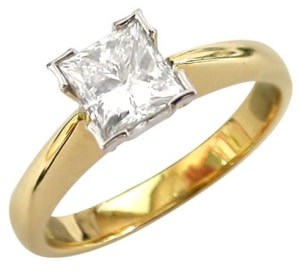
How much do gold diamond engagement rings cost?
Most cost about $1,000 to $6,000, and the diamond accounts for most of the price. The gold in a simple band is a smaller part: with gold near $4,123 an ounce (Fortune), a 3 gram 14K band holds roughly $230 of gold and a 4 gram 18K band about $400.
| Budget tier | Typical ring | Approximate total |
|---|---|---|
| Budget | Lab-grown 1 ct round in a 14K solitaire | $1,000 to $2,000 |
| Mid-range | Natural 0.50 to 0.90 ct round, 14K setting | $1,500 to $4,000 |
| Classic | Natural 1 ct round, 14K or 18K setting | $4,200 to $6,000 |
| Luxury | Natural 2 ct round, 18K halo or pave | $16,500 and up |
Diamond medians behind these tiers are about $924 for a natural 0.50 carat round, $3,710 for 1 carat and $15,776 for 2 carats, against $606 for a lab-grown 1 carat (CaratRadar). Use our diamond price calculator for other grades, and read our lab-grown diamonds guide if budget comes first.

Will gold engagement ring prices change next year?
Gold prices have been at record highs, so gold settings cost more than they did a few years ago and will keep moving with the metal. Natural diamond prices have been drifting slightly lower and lab-grown prices keep falling. Expect totals close to the ranges above, and check live prices before you buy.
Which diamonds and settings look best in gold?
A well-cut round brilliant looks superb in any gold color, and fancy shapes such as ovals and cushions suit yellow and rose gold especially well. Cut matters most: a bright cut diamond throws far more light than a poorly cut one of higher color.
The yellow color shows off the white of a well-cut diamond, and it is hard not to be drawn to the fire of a fine diamond sitting in a gold setting. Many buyers use white gold or platinum prongs on a yellow gold band, so a colorless diamond stays icy-white while the band stays warm. Colored stones shine in matching metals too; pink rings look their best in rose gold, and a classic round diamond engagement ring works in all three.
How do you buy a gold diamond ring with confidence?
Buy from a reputable jeweler that provides a grading report for the diamond, a clear karat stamp on the band and a fair return policy. Those three things protect you more than any discount.
- Choose the gold color, then the karat (14K for most people).
- Pick the diamond with a GIA or IGI report, putting cut first.
- Check the karat stamp and the jeweler’s warranty on prongs and plating.
- Get your size right with our ring size chart before ordering.
- Confirm the return window covers the finished ring.
Online jewelers such as James Allen let you pair a graded diamond with settings in yellow, white or rose gold and view them on video.
How this guide was researched: gold history and properties come from Wikipedia’s gold, Amarna letters, colored gold and fineness articles, metal popularity from The Knot’s study as reported by Rapaport, karat rules from the FTC jewelry guides, and prices from Fortune’s gold price report and CaratRadar’s tracked diamond listings.
Frequently asked questions about gold diamond engagement rings
Is 14K or 18K gold better for a diamond engagement ring?
14K is better for most people because it is harder and cheaper while still looking rich. 18K has 75% gold and a deeper color but scratches and wears faster.
Which gold color makes a diamond look whitest?
White gold makes a colorless diamond look the iciest. Yellow gold can make a near-colorless diamond look slightly warmer, so many buyers use white prongs on a yellow band.
Is yellow gold still popular for engagement rings?
Yes. Yellow gold was the most popular engagement ring metal in The Knot's latest study, chosen by 39% of couples.
Why isn't 24K gold used for engagement rings?
Pure 24K gold is too soft. It bends and scratches easily, and prongs can loosen and let the diamond fall out, so it is alloyed to 18K, 14K or 10K.
What is rose gold made of?
Rose gold is gold alloyed mainly with copper. 18K rose gold is about 75% gold, 22.25% copper and 2.75% silver; more copper makes it redder.
How much does a gold diamond engagement ring cost?
Most cost about $1,000 to $6,000. A lab-grown 1 carat in 14K gold can be under $2,000, while a natural 1 carat ring usually costs $4,200 to $6,000.
Is gold or platinum better for a diamond ring?
Gold is lighter and usually cheaper, and comes in three colors. Platinum is naturally white, denser and very low allergy risk, but costs more.
Does a gold engagement ring tarnish?
No. Gold does not tarnish. Yellow and rose gold only need occasional polishing, while white gold needs rhodium replating every few years to stay bright white.
Ready to choose your gold ring?
Pick yellow, white or rose gold to suit the diamond and your skin, choose 14K for everyday wear, buy a well-cut diamond with a report, and check the karat stamp. For more guides, visit our Home page.
Anthony Chege is a gem and jewelry dealer with 20 years’ experience sourcing, grading and selling diamonds, gemstones and gold. He writes for Diamond Rings Info on diamond grading, pricing and buying.
Home | Gold Rings