
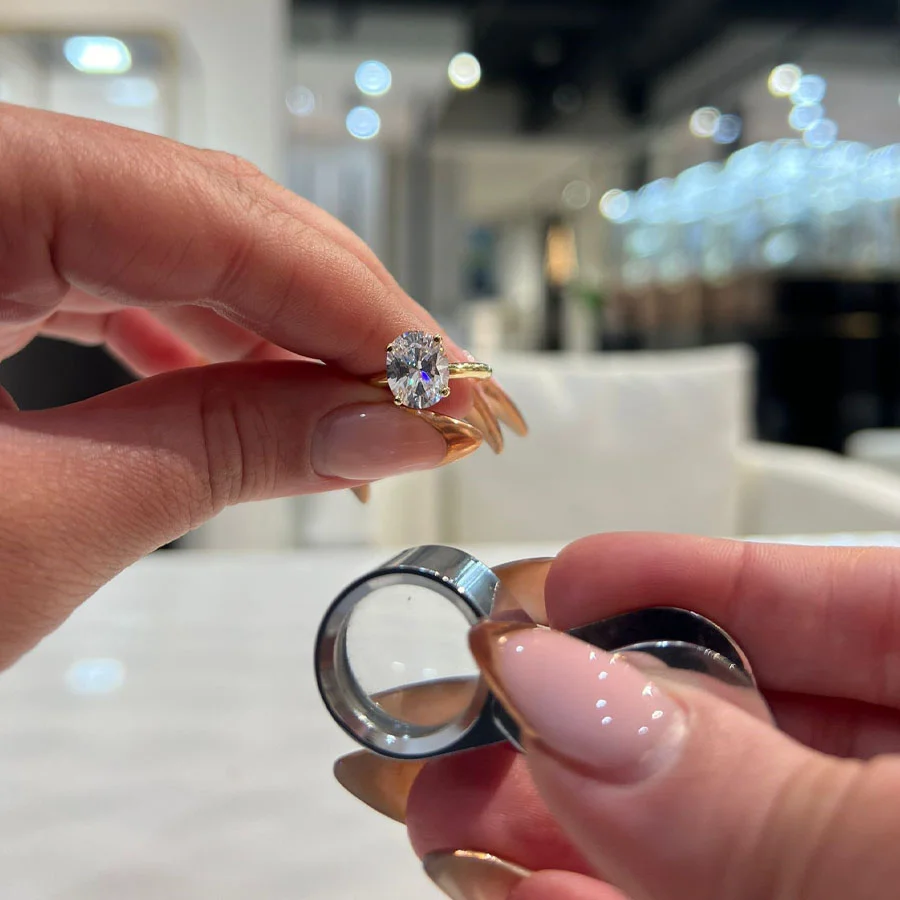
How to tell if a diamond is real? Start with its grading report and laser inscription, then check the metal stamp, do a fog and read-through test, inspect it under a 10x loupe, and confirm with a jeweler’s multi-tester or a gem lab.
Last updated: October 2026 · Checked against GIA, IGI and GCAL guidance
Key Takeaways
- No single home test is conclusive; combine several and confirm with a professional
- Diamond’s refractive index is 2.42; moissanite’s is about 2.65 and cubic zirconia’s 2.15–2.18 — Moissanite, Cubic zirconia
- Cubic zirconia is about 1.7 times heavier than a diamond of the same size
- Thermal testers cannot separate moissanite from diamond; electrical “multi” testers were developed after moissanite appeared around 1999 — GCAL
- Only 25–35% of diamonds fluoresce under UV, so a UV check proves little on its own — GIA
- Lab-grown diamonds are real diamonds and pass every home test; only a gem lab can tell them from natural
- In 2024 IGI caught a 6.01 ct lab-grown stone inscribed with a natural diamond’s report number — IGI

What does “real diamond” actually mean?
A real diamond is crystallized carbon, whether it was mined from the earth or grown in a laboratory. Fakes are simulants: different materials such as cubic zirconia (CZ), moissanite, white sapphire or glass that only look like diamond.
That distinction matters because the tests below catch simulants, not lab-grown diamonds. A lab-grown diamond will pass every home check because it is a diamond. To learn how they compare, read our lab created vs real diamonds guide, and see our overview of imitation diamond rings for the common fakes.
Step 1: Does the diamond come with a grading report?
Ask for an independent grading report from a lab such as GIA, IGI or AGS, and look up its number online. On GIA stones, use GIA Report Check; IGI and other labs offer the same.
Most graded diamonds have the report number laser-inscribed on the girdle, the thin edge around the stone. Check it with a 10x loupe and make sure it matches the report. But don’t stop there: in January 2024 IGI found a 6.01-carat lab-grown stone inscribed with the report number of a natural diamond (IGI). “Everyone in our industry must be vigilant,” said IGI chief executive Tehmasp Printer. Our diamond certificate guide shows how to read a report.
Step 2: What do the metal stamps on the setting say?
Look inside the band for a metal stamp. Marks such as 10K, 14K, 18K, 585, 750, PT or PT950 mean gold or platinum, which jewelers normally reserve for real stones; “925” means sterling silver, and “C.Z.” means cubic zirconia.
A precious-metal stamp is a good sign, not proof — real diamonds can be set in silver and fakes in gold, especially in vintage or custom pieces. Our guides to platinum rings and gold rings explain the marks.
Step 3: How do you do the fog test on a diamond?
Breathe on the stone as if fogging a mirror and watch it. A diamond disperses heat quickly, so the fog clears almost at once; most simulants stay misty for a few seconds.

Clean the stone first, because grease holds condensation. Moissanite also conducts heat well and can pass the fog test, so treat a “pass” as a first filter only.
Step 4: What is the read-through or dot test?
Place a loose stone table-down on a page of printed text or on a small dot drawn on white paper. A well-cut diamond bends light so strongly that you can’t read the text or see the dot through it; with glass or CZ, the print usually shows through.

This works only on loose stones, and poorly cut diamonds can let some print through. Moissanite, which bends light even more than diamond, also passes.
Step 5: What kind of sparkle does the stone show?
Look at the stone in daylight. A diamond shows a mix of white brilliance and colored fire; a stone throwing strong “disco ball” rainbow flashes everywhere is often moissanite.
The reason is dispersion, a stone’s ability to split light into colors. Moissanite’s dispersion is about 0.104 and CZ’s 0.058–0.066, both higher than diamond’s 0.044 (Wikipedia). Our moissanite and cubic zirconia guides show the difference in more detail.
Step 6: What should you look for under a 10x loupe?
Under 10x magnification, a diamond has crisp, sharp facet edges and usually tiny natural inclusions. Cubic zirconia often shows rounded, worn facet edges, and moissanite shows “doubled” facet lines because it is doubly refractive.

Diamond is 10 on the Mohs hardness scale, against about 9.5 for moissanite and 8–8.5 for CZ, so a simulant worn for years shows scratched, rounded edges that a diamond resists. Inclusions are a good sign too: a perfectly flawless stone at a low price is suspicious. Compare what you see with our clarity chart and read more on diamond hardness.
Step 7: Can weight or water tell if a diamond is real?
Yes, for loose stones. Cubic zirconia is about 1.7 times as dense as diamond, so a CZ the same size as a 1-carat diamond weighs roughly 1.7 carats on a jeweler’s scale.
The popular water test, dropping the stone in a glass of water, is weak: diamonds sink, but so do CZ and most simulants. Only very light glass or plastic fakes give themselves away by sinking slowly.
| Property | Diamond | Moissanite | Cubic zirconia |
|---|---|---|---|
| Refractive index | 2.42 | 2.65–2.97 (doubly refractive) | 2.15–2.18 |
| Dispersion (fire) | 0.044 | 0.104 | 0.058–0.066 |
| Mohs hardness | 10 | ~9.5 | 8–8.5 |
| Specific gravity | 3.52 | 3.22 | 5.6–6.0 |
| Thermal tester result | Diamond | Diamond (fooled) | Not diamond |
| Electrical tester result | Diamond* | Moissanite | Not diamond |
*Many lab-grown and natural blue diamonds conduct electricity and can read as moissanite on a multi-tester (GCAL). Properties from Wikipedia’s moissanite, cubic zirconia and diamond entries.
Step 8: Does a UV light help tell if a diamond is real?
Only a little. Under a UV (black) light, many diamonds glow blue, but GIA says just 25–35% of diamonds show any fluorescence, and more than 95% of those glow blue (GIA).
A blue glow is a mildly positive sign; no glow tells you nothing, because most real diamonds don’t fluoresce. Lab-grown diamonds often show weak or no fluorescence too.

Step 9: How do jewelers and labs confirm a diamond is real?
A jeweler uses an electronic tester, then a gem lab confirms with spectroscopy if needed. Thermal testers, introduced in the early 1980s, separate diamond from CZ but not moissanite; electrical “multi” testers were added after moissanite arrived around 1999 (GCAL).

Testers have limits: many lab-grown diamonds and natural blue diamonds conduct electricity and can falsely read as moissanite. When the stakes are high, a gem lab is the final word. In the IGI case above, photoluminescence spectroscopy revealed the stone’s CVD lab-grown origin. A professional appraisal is also worth getting for insurance.
Which red flags suggest a diamond is fake?
Common red flags are a price far below market, no grading report, a “flawless” look with no inclusions at all, rounded or scratched facet edges, rainbow-heavy sparkle, and a silver or unstamped setting. Our guide to fake diamond rings covers more warning signs.
If you’re buying secondhand, make any sale conditional on an independent test — see our tips on used diamond rings. If you’re selling, a current report makes buyers trust the stone; read our guide to selling a diamond ring.
How we researched this guide
This guide is based on Anthony Chege’s 20 years of testing and grading stones in the gem trade, checked against GIA fluorescence data, GCAL’s guidance on diamond testers, IGI’s 2024 fraud alert and published gemological properties of diamond, moissanite and cubic zirconia. Home tests are screening tools only; confirm any valuable stone with a qualified jeweler or gem lab.
Frequently asked questions about how to tell if a diamond is real
What is the easiest way to tell if a diamond is real at home?
Start with the fog test and, for loose stones, the read-through test. Breathe on the stone: a real diamond clears in a second or two. These are quick screens only, so confirm with a jeweler’s tester or a lab report.
Does a real diamond sparkle rainbow colors?
A real diamond shows a mix of white light (brilliance) and some colored flashes (fire). Moissanite throws much more rainbow fire because its dispersion is 0.104 versus 0.044 for diamond.
Can a diamond tester tell the difference between a diamond and moissanite?
A basic thermal tester cannot, because moissanite conducts heat like diamond. A multi-tester that also measures electrical conductivity can, since moissanite conducts electricity and almost all diamonds do not.
Will a lab-grown diamond pass a diamond tester?
Yes. Lab-grown diamonds are real diamonds with the same chemistry and properties, so they pass thermal and multi-testers. Only a gem lab with advanced instruments can confirm whether a diamond is natural or lab-grown.
Can you tell if a diamond is real by scratching glass?
No. Many simulants, including moissanite and some cubic zirconia, can also scratch glass, and the test can chip the stone. It proves little and risks damage.
Does a real diamond float or sink in water?
A real diamond sinks because its specific gravity is 3.52. Most simulants sink too, so the water test cannot tell a diamond from a fake.
How much does it cost to get a diamond tested?
Many jewelers test stones for free or a small fee while you wait. A full GIA grading report costs more and depends on carat weight, and an insurance appraisal is a separate paid service.
What does GIA inscribed on a diamond mean?
It means the report number is laser-inscribed on the diamond’s girdle. You can read it under a 10x loupe and match it to the report at GIA’s Report Check website.
Still not sure?
Ask for an independent grading report and an appraisal before you buy, and read our fake diamond rings guide.
Anthony Chege is a gem and jewellery dealer with 20 years’ experience sourcing, testing, grading and selling diamonds and coloured gemstones. He writes for Diamond Rings Info on diamond grading, pricing and buying.