
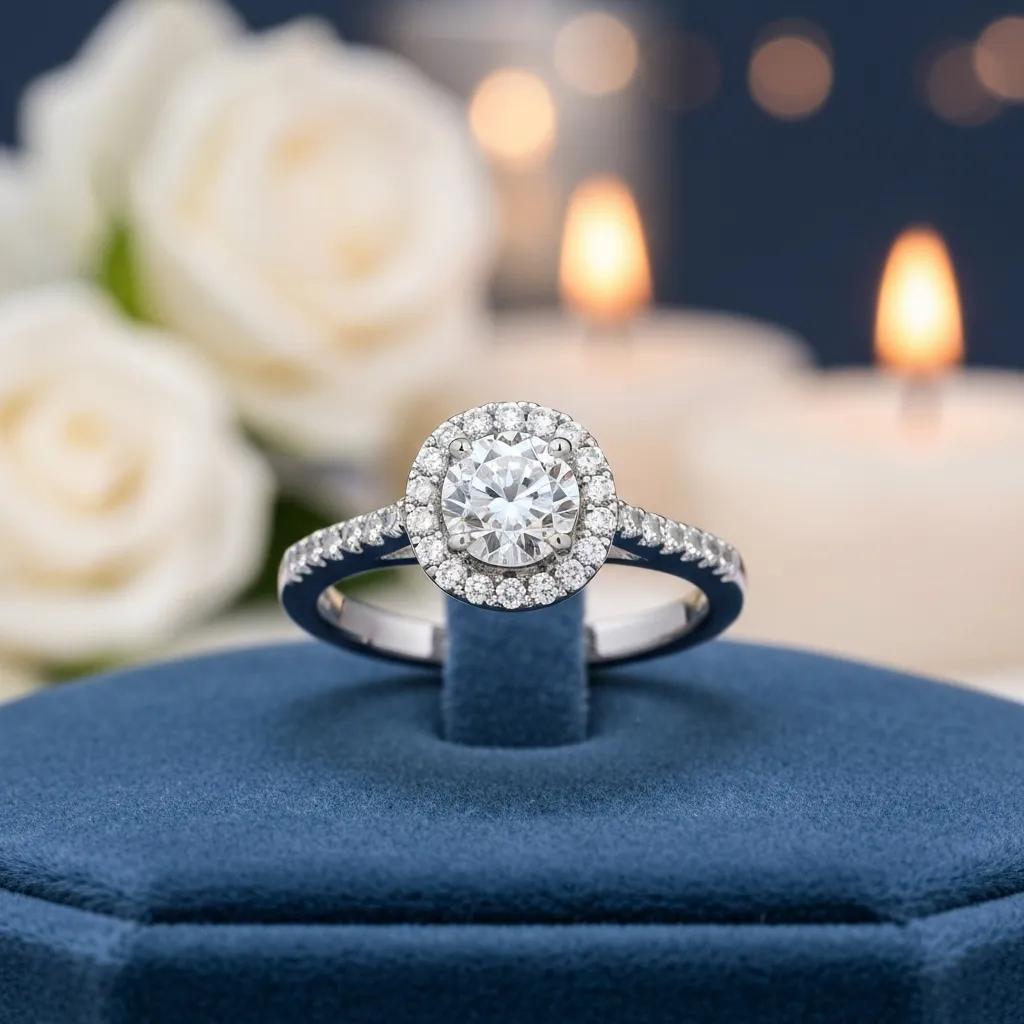
Why choose round diamond engagement rings? A round brilliant diamond has 58 facets designed to return the most light, so it sparkles more than any other shape. It is the most popular center stone, and a natural 1 carat round has a median price near $3,700.
Last updated: November 2026 · Checked against cutting history, survey data and tracked online prices
Key Takeaways
- The modern round brilliant has 58 facets: 33 on the crown and 25 on the pavilion, counting the culet (Wikipedia)
- Marcel Tolkowsky set out its ideal proportions in 1919 in his book Diamond Design
- Round is the most popular shape: 28% of engagement rings have a round center stone, just ahead of oval at 25% (The Knot)
- Lab-grown diamonds now make up 52% of engagement ring center stones in the same study
- A natural 1 carat round has a median price of $3,710, and a lab-grown one $606 (CaratRadar)
- GIA gives a full cut grade, from Excellent to Poor, to standard round brilliants, so cut quality is easy to compare (GIA)

Diamond Rings Info may earn a commission if you buy through links on this page, at no extra cost to you.
What is a round brilliant diamond?
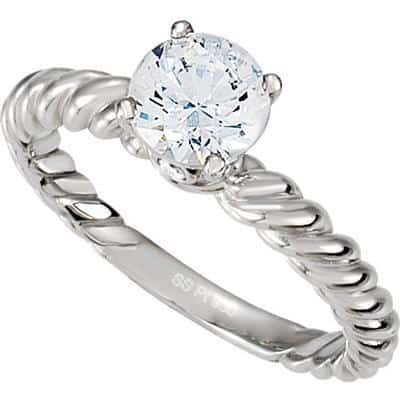
A round brilliant is a circular diamond cut with 58 facets arranged like two pyramids placed base to base. The top half, the crown, has 33 facets and is the part you see in a ring; the lower half, the pavilion, has 25 facets including the tiny culet at the point, and is mostly hidden by the setting.
Every facet is angled to bounce light back out through the top of the stone. That is why a well-made round looks so bright, and why the word “brilliant” became shorthand for the shape. Wikipedia’s article on the Round diamond describes the facet layout in detail, and our guide to diamond cut explains how cut differs from shape.
Who invented the round brilliant cut?
No single person invented it. The round brilliant evolved over centuries, and in 1919 Marcel Tolkowsky published Diamond Design, which calculated the proportions that give the best balance of brightness and fire. His model became the basis of the modern round brilliant.
Earlier versions came first. By around 1750 cutters were making the Old European cut, with a rounded girdle, and the transitional brilliant followed in the late 1800s once bruting machines could round stones accurately. Tolkowsky’s ideal had a table of about 53% of the diameter; modern cutters adjust his numbers slightly, often with a wider table, and use computer scanning and lasers to plan and saw each stone. Our guide to diamond cutting covers the process step by step.
Why are round diamonds the most popular shape?
Round diamonds lead because they sparkle the most, suit every setting and never date. In The Knot’s latest Jewelry and Engagement Study, 28% of engagement rings had a round center stone, ahead of oval at 25% (The Knot).
There is also a practical reason. Many diamond crystals grow as octahedrons, and from that kind of rough diamond, a cutter can often saw two round stones. Crystals of other shapes are usually cut into fancy shapes such as princess, cushion or pear.
| Advantage | Why it matters |
|---|---|
| Most brilliance | The 58-facet design returns more light than any other shape |
| Hides flaws and tint | Strong sparkle masks small inclusions and a hint of color |
| Durable outline | No sharp corners to chip, unlike princess or marquise cuts |
| Fits any setting | Easy to set in prongs, bezels, halos and tension settings |
| Clear cut grades | GIA grades round cut quality from Excellent to Poor |
Do round diamonds lose more rough when cut?
Yes, usually. Wikipedia notes that cutting always causes a dramatic loss of weight, and the loss is rarely less than 50%. So a 3 carat crystal might yield a polished round of about 1.5 carats or less.
That loss is one reason round diamonds cost more per carat than most fancy shapes: the cutter sacrifices weight to get the ideal proportions. Fancy shapes such as oval, cushion and princess can follow the crystal more closely and keep more weight.
What grades should you choose for a round diamond?
Put cut first: choose GIA Excellent or an equivalent ideal grade, then save on color and clarity. Because a round hides tint and small inclusions well, an eye-clean stone in the middle grades looks beautiful.
- Cut: Excellent or Ideal only. A poorly cut round looks dull or dark in the center, whatever its other grades.
- Color: G to I looks white in white metal, and H to K works in yellow gold; see our diamond color chart.
- Clarity: an eye-clean VS2 or SI1 is the best value; see our diamond clarity chart.
- Carat: a 0.90 carat round looks almost the same as 1 carat and costs far less.
How much do round diamond engagement rings cost?
Most cost about $1,000 to $6,000, and the diamond is the biggest part of the price. A lab-grown 1 carat round can be set for under $2,000, while a natural 1 carat round ring usually costs $4,200 to $6,000.
| Budget tier | Typical ring | Approximate total |
|---|---|---|
| Budget | Lab-grown 1 ct round, 14K solitaire | $1,000 to $2,000 |
| Mid-range | Natural 0.50 to 0.90 ct round, simple setting | $1,500 to $4,000 |
| Classic | Natural 1 ct round, gold or platinum setting | $4,200 to $6,000 |
| Luxury | Natural 2 ct round, halo or pave | $16,500 and up |
The loose diamond medians behind these tiers are about $924 for a natural 0.50 carat round, $2,321 for 0.90 carat, $3,710 for 1 carat and $15,776 for 2 carats. Lab-grown rounds are far cheaper, at about $606 for 1 carat and $1,158 for 2 carats (CaratRadar).
Rounds usually carry a premium. A natural 1 carat round’s median of $3,710 compares with $2,673 for a 1 carat cushion, about 39% more (CaratRadar), although at 2 carats popular ovals were priced about the same as rounds. Try our diamond price calculator for other grades, or read our lab-grown diamonds guide to see how far a budget can go.

Will round diamond prices change next year?
Natural round diamond prices have been soft, drifting slightly lower in tracked online listings, while lab-grown prices keep falling as production grows. Round stones are always in demand, so expect natural prices to stay close to today’s medians and lab-grown rounds to keep getting cheaper. Check current listings before you buy.
Which settings suit a round diamond?
A round diamond suits almost every setting, because its even outline has no corners to protect. The right choice depends on your style and how active your hands are.
- Four- or six-prong solitaire: the classic look; six prongs give a rounder outline and extra security.
- Halo: a ring of small diamonds makes the center look larger.
- Bezel: a metal rim protects the edge, ideal for people who work with their hands.
- Three-stone and pave: extra sparkle beside the center or along the band.
For metal, a white gold diamond engagement ring keeps a colorless round looking icy, while yellow gold warms it. If you are still weighing shapes, compare our guides to oval engagement rings and princess cut engagement rings.
How do you buy a round diamond ring safely?
Buy a round with a GIA or IGI report, check the cut grade and proportions, and see the actual stone on video or in person. Those three steps protect you more than any discount.
- Choose natural or lab-grown, then set a budget for the stone and the setting.
- Filter for Excellent or Ideal cut, then for color and clarity.
- Look up the report number on the lab’s website and check that it matches the girdle inscription.
- Watch magnified video to confirm the stone is eye-clean and bright.
- Confirm the return policy covers the finished ring.
Online jewelers such as James Allen list thousands of graded round diamonds with 360-degree video, which makes side-by-side comparison easy. For more shapes and styles, see our Engagement Rings guide.
How this guide was researched: cutting history and facet counts come from Wikipedia’s brilliant cut article, shape and lab-grown shares from The Knot’s Jewelry and Engagement Study, cut grading from GIA, and prices from CaratRadar’s medians of tens of thousands of tracked round diamond listings.
Frequently asked questions about round diamond rings
Why are round diamonds so popular?
They sparkle more than any other shape, suit every setting and never go out of style. In The Knot’s latest study, 28% of engagement rings had a round center stone, the most of any shape.
How many facets does a round brilliant diamond have?
A modern round brilliant has 58 facets: 33 on the crown and 25 on the pavilion, including the culet. If the culet is not counted, it has 57.
Who designed the round brilliant cut?
The shape evolved over centuries, from the Old European cut to the transitional brilliant. In 1919 Marcel Tolkowsky published Diamond Design, which set out the proportions behind the modern round brilliant.
Are round diamonds more expensive than other shapes?
Usually yes, because more rough is lost in cutting. A natural 1 carat round has a median price of $3,710, compared with $2,673 for a 1 carat cushion.
How much does a 1 carat round diamond ring cost?
A natural 1 carat round ring typically costs about $4,200 to $6,000 including a simple setting. A lab-grown 1 carat round ring can cost under $2,000.
What is the best cut grade for a round diamond?
Choose GIA Excellent or an equivalent ideal grade. Cut has the biggest effect on a round’s sparkle, so it is worth paying for before color or clarity.
What color and clarity should a round diamond have?
An eye-clean VS2 or SI1 in G to I color offers the best value in white metal. Rounds hide small inclusions and slight tint well.
Is a round or oval diamond better?
A round gives the most sparkle and a timeless look, while an oval looks larger for its weight and lengthens the finger. Both are excellent choices; it comes down to taste.
Ready to choose your round diamond?
Put cut first, pick an eye-clean stone in G to I color, consider 0.90 carat to save, choose natural or lab-grown, and insist on a grading report. For more guides, visit Diamond Info.
Anthony Chege is a gem and jewelry dealer with 20 years’ experience sourcing, grading and selling diamonds, gemstones and gold. He writes for Diamond Rings Info on diamond grading, pricing and buying.
Diamond Info | Engagement Rings | Round Diamond Rings