
What is a rough diamond? A rough diamond is a natural diamond crystal as it comes out of the ground, before cutting and polishing. It often looks like frosted glass, loses about half its weight when cut, and Russia, Botswana, Angola and Canada mine the most.
Last updated: November 2026 · Checked against Kimberley Process production data
Key Takeaways
- Russia mined about 37.3 million carats of rough in the latest Kimberley Process data, followed by Botswana at 18.1 million (Wikipedia)
- Cutting and polishing an uncut diamond typically loses about 50% of its weight (Wikipedia)
- The Kimberley Process, launched in 2003, requires a certificate with every rough export and has 59 participants representing 85 countries (Wikipedia)
- Average rough values range widely, from about $75 a carat in Botswana’s output to about $124 in South Africa’s
- About 112 million carats of uncut diamonds were traded worldwide in a single recent year (Wikipedia)
- Buying rough without expert knowledge is risky: quartz, glass and other minerals can look much the same

Diamond Rings Info may earn a commission if you buy through links on this page, at no extra cost to you.
What is a rough diamond?
A rough diamond is an uncut natural diamond crystal, the raw material from which every polished diamond is made. To most people it looks unremarkable: a greasy, frosted pebble rather than a sparkling gem, which is why the phrase “a diamond in the rough” means hidden potential.
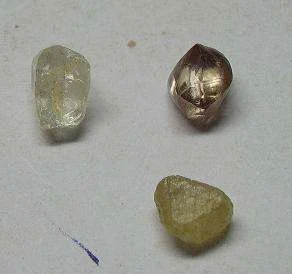
Uncut diamonds grow in typical crystal shapes. The classic form is the octahedron, two four-sided pyramids joined at the base, while flat triangular twins called macles are usually cut into fancy shapes. You can see how a rough stone is transformed in this short video.
How can you recognize an uncut diamond?
An uncut diamond usually has a frosted or oily-looking surface, sharp crystal edges or triangular markings, and a high density for its size. But many minerals look similar, and only testing confirms a diamond.
| Feature | Rough diamond | Common look-alikes |
|---|---|---|
| Surface | Greasy, frosted luster | Quartz and glass look glassy and clear |
| Shape | Octahedrons, macles, rounded crystals | Quartz forms six-sided columns |
| Hardness | 10 on the Mohs scale | Quartz is 7, glass about 5.5 |
| Proof | Thermal or lab testing | Fails a diamond tester |
Many people have lost money buying “uncut diamonds” that turned out to be quartz or glass. Leave identification to a gemologist, and see our guide on how to tell if a diamond is real for the tests a lab uses.
Where do rough diamonds come from?
Most uncut diamonds now come from Russia, Botswana, Angola and Canada. Africa remains a major source, but the old claim that nearly all diamonds come from a handful of African countries is out of date: Russia alone mines about twice as many carats as Botswana.
| Country | Carats mined | Average value per carat |
|---|---|---|
| Russia | 37.3 million | About $89 |
| Botswana | 18.1 million | About $75 |
| Angola | 14.0 million | About $101 |
| Canada | 13.3 million | About $81 |
| South Africa | 5.3 million | About $124 |
These figures come from Kimberley Process data compiled by Wikipedia for the latest reported year. Average value varies with quality: a country producing many small industrial stones has a low average even if it also finds some exceptional gems.

What are conflict diamonds?
Conflict or “blood” diamonds are uncut diamonds mined or traded in areas of armed conflict and used to fund rebel groups. In the 1990s and 2000s they financed wars in Sierra Leone, Angola, Liberia and the Democratic Republic of Congo (Wikipedia).
The Kimberley Process was set up in 2003 to stop them: every rough export must carry a certificate, and members may not trade with non-members. It has helped, but critics say it is too narrow; Global Witness left the scheme in 2011. Buy from sellers who can explain where their diamonds come from.
How is an uncut diamond turned into a polished gem?
A rough stone is planned with computer scanning, split by cleaving or sawing, rounded by bruting, and then faceted and polished. The cutter’s goal is the best balance of weight, beauty and value, and about half the original weight is usually lost along the way.
- Planning: software maps the crystal and its inclusions to choose the most valuable cut.
- Cleaving or sawing: the rough is split along its grain or sawn with a blade or laser.
- Bruting: the girdle is rounded for round brilliant cuts.
- Faceting and polishing: facets are ground and polished to create brilliance and fire.
Our guides to diamond cutting and diamond cut explain the process and how cut quality affects sparkle. Once polished, every stone is graded; see our Diamond Grades guide.
How much is a rough diamond worth?
Most uncut diamonds are worth far less per carat than polished ones, because half the weight is lost in cutting and many stones are only fit for industrial use. National averages run from about $75 to $124 per carat in the main producing countries, while large, clean gem rough can fetch many thousands of dollars per carat.
Value depends on size, shape, color and clarity, and on how much polished weight the rough will yield. Rough is sold through contracts, tenders and auctions to manufacturers, as our guide to wholesale loose diamonds explains, so private individuals rarely get fair prices for it.
Will uncut diamond prices change next year?
Rough prices have been under pressure as lab-grown diamonds take market share and demand for natural stones softens. Natural rough should stay valuable because supply is limited, but expect prices to move with the polished market. For shoppers, the polished price is what matters, and our loose diamonds guide tracks typical prices.
Should you buy an uncut diamond?
Only if you have expert help or want an uncut diamond for its natural look. Some people choose raw diamonds for rustic rings, and a few colored rough stones, such as yellow diamonds, look striking uncut.
For a sparkling ring, a polished stone with a grading report is the safer buy. If budget is the main concern, compare lab-grown diamonds, and watch out for fake diamond rings. Online jewelers such as James Allen sell graded natural and lab-grown diamonds with video, and our diamond engagement rings guide covers settings.
How this guide was researched: production figures come from Kimberley Process data as compiled by Wikipedia, cutting facts from Wikipedia’s diamond cutting article, and conflict diamond history from Wikipedia’s blood diamond and Kimberley Process articles.
Frequently asked questions about rough diamonds
What does an uncut diamond look like?
It usually looks like a frosted or greasy pebble, often shaped as an octahedron or a flat triangular macle. It has none of the sparkle of a polished diamond until it is cut.
How much is an uncut diamond worth?
Average mined output is worth roughly $75 to $124 per carat in the main producing countries, but large, clean gem-quality crystals can be worth thousands of dollars per carat.
Which country mines the most diamonds?
Russia, with about 37.3 million carats in the latest Kimberley Process data, followed by Botswana, Angola and Canada.
How much weight is lost when cutting a diamond?
About half. Cutting and polishing typically removes around 50% of the original weight.
Is it legal to buy rough diamonds?
Yes, but international shipments of uncut stones must carry a Kimberley Process certificate, and some countries license rough dealing. Buy only from licensed, reputable sellers.
How can I tell if an uncut stone is a diamond?
Look for a greasy luster and crystal shapes, but only a gemologist’s thermal or lab test can confirm it, because quartz and glass can look very similar.
What is the Kimberley Process?
It is an international certification scheme launched in 2003 to keep conflict diamonds out of the trade in uncut stones, with 59 participants representing 85 countries.
Can you wear an uncut diamond in a ring?
Yes. Raw diamond rings are popular for a natural look, but they lack sparkle and their irregular shapes need custom settings to hold them securely.
Want a diamond you can trust?
Appreciate uncut diamonds for what they are, leave buying them to experts, and choose a polished, graded diamond from a seller who can explain its origin. For more guides, visit our Home page.
Anthony Chege is a gem and jewelry dealer with 20 years’ experience sourcing, grading and selling rough and polished diamonds, gemstones and gold. He writes for Diamond Rings Info on diamond grading, pricing and buying.
Home | Diamond Grades | Rough Diamond