
Are pink diamond engagement rings worth it? Pink diamond engagement rings are worth it if you love the color and buy with your eyes open: natural pinks are among the rarest gems on earth and priced to match, while treated and lab-grown pinks give the same look for far less.
Last updated: October 2026 · Facts checked against GIA research and published auction results
Key Takeaways
- About 99.5% of pink diamonds get their color from distortion in the crystal structure, not from manganese or other impurities (GIA)
- Australia’s Argyle mine produced over 90% of the world’s pink diamonds before it closed in 2020 (Phys.org)
- The 11.15-carat Williamson Pink Star sold for $57.7 million in 2022, a record $5.2 million per carat (National Jeweler)
- Color intensity drives the price of a pink diamond far more than clarity does
- Treated and lab-grown pinks are real diamonds but must be disclosed, so always ask for a grading report that states the color origin
- Rose gold flatters pale pinks, while platinum and a white-diamond halo make stronger pinks stand out

Diamond Rings Info may earn a commission if you buy through links on this page, at no extra cost to you.
Put a natural pink next to a tray of white diamonds and the whites suddenly look plain. That appeal also attracts pink “bargains” that aren’t what they seem, so read the grading report before you fall for a stone.
What makes a pink diamond pink?
A pink diamond gets its color from its crystal structure being squeezed and bent deep in the earth. GIA researchers say that “the color of 99.5% of pink diamonds comes from distortion in their crystal structure,” a process called plastic deformation (GIA).
Many guides still blame manganese, but that’s a myth. Yellow comes from nitrogen and blue from boron, but pink is a structural story, a bit like a sheet of glass that catches the light differently once it’s been bent. The same process is linked to the even rarer red diamonds.
Why are pink diamond engagement rings so rare?
Pink diamond engagement rings are rare because almost all the world’s supply came from one mine, and it has shut. Australia’s Argyle mine produced over 90% of the world’s pink diamonds before Rio Tinto closed it in November 2020 after 37 years (Phys.org).
Even at Argyle, pinks were a tiny sliver of output: only about 0.1% of the mine’s yearly production was classed as pink (Wikipedia). Smaller numbers come from Tanzania, Russia, Brazil and South Africa, and Angola’s Lulo mine produced a 170-carat pink called the Lulo Rose in 2022. From my years handling African rough, I can tell you that gem-quality pinks are among the rarest finds in the trade.
Which famous pink diamonds shaped the trend?
Royal and celebrity stones made pink a popular engagement choice. The 23.6-carat Williamson Pink, cut from a Tanzanian rough, was a wedding gift to Princess Elizabeth in 1947. It’s often called an engagement ring, but it was set in a brooch (Wikipedia).
The modern craze started in 2002, when Ben Affleck proposed to Jennifer Lopez with a 6.1-carat pink diamond ring. Some guides put it at 8.5 carats, but 6.1 carats is the figure most widely reported. The ring helped push pink prices up. Auction houses have since set records that read like phone numbers; see more in our guide to the most famous and expensive diamonds.
| Diamond | Weight and color | Sale | Price |
|---|---|---|---|
| CTF Pink Star | 59.60 ct Fancy Vivid pink | Sotheby’s Hong Kong, 2017 | $71.2 million |
| Williamson Pink Star | 11.15 ct Fancy Vivid pink | Sotheby’s Hong Kong, 2022 | $57.7 million ($5.2M per carat) |
| Winston Pink Legacy | 18.96 ct Fancy Vivid pink | Christie’s Geneva, 2018 | About $2.7M per carat |
Figures from National Jeweler.
How are pink diamonds graded?
Pink diamonds are graded mainly on the strength and purity of their color, not on the D-to-Z scale used for white stones. GIA’s colored diamond report describes the color by hue, tone and saturation and states whether the color is natural (GIA). The intensity grades run from Faint to Fancy Vivid.
Watch the modifiers too. “Purplish pink” is prized, while “brownish pink” or “orangy pink” costs much less and can look muddy. Clarity matters less than color here; I’d happily take an SI clarity stone with a lovely, even pink over a flawless pale one. Our diamond color chart explains the white-diamond scale, and our guide to the diamond certificate shows what to check on any report.
How much does a pink diamond engagement ring cost?
A natural pink diamond engagement ring can cost anywhere from about $10,000 for a small, pale stone to millions for a large vivid one. Example retail listings on Diamonds.pro include a 0.60-carat Fancy Light orangy pink for $10,900 and a 0.58-carat Fancy Vivid purplish pink for $174,100 (Diamonds.pro). Top stones reach up to $3 million per carat, and Rio Tinto said pink values rose about 500% over two decades before Argyle closed (Phys.org).

On a normal budget, the smartest route is often a white center stone with small natural pink accents, or a pink center under half a carat. Just don’t buy one as an investment. Resale for jewelry is far below retail, and you should buy a ring because you want to wear it.
Natural, treated or lab-grown pink: which should you choose?
Choose natural if rarity matters to you, and treated or lab-grown if you want the color at a sensible price. All three are real diamonds, but the price gap is huge, and the FTC expects sellers to disclose treatments that affect value (FTC).
| Type | How it gets its color | Price | Watch out for |
|---|---|---|---|
| Natural pink | Crystal distortion in the earth | Highest by far | Insist on a GIA report stating natural color |
| Treated natural | Irradiation and heating, or a surface coating | Much lower | Coatings can wear off; must be disclosed |
| Lab-grown pink | Grown by CVD or HPHT, then usually treated | Lowest diamond option | Little resale value; check the report says lab-grown |
| Pink sapphire | Chromium in corundum | Low to moderate | Not a diamond, slightly softer |
Lab-grown pinks are usually given their color after growth by irradiation and annealing (Wikipedia). That’s fine if you know what you’re paying for; see our guide to lab-grown diamonds and our explainer on diamond enhancement. If a “natural pink” is priced like a lab stone, assume it isn’t natural.
I learned how costly that assumption can be with another colored gem. A tech executive once asked me to match a suspiciously cheap 10-carat emerald he’d found from an unverified overseas wholesaler. I could see it was heavily oil-treated to hide large fractures, so under the microscope I set an untreated 3-carat emerald beside a heavily treated 8-carat stone. Buying it for its size, I told him, was like buying a Ferrari with a cracked engine block. He chose a vivid 4-carat sapphire instead. The same goes for pink diamonds: a low price tells you nothing about what you’re buying, but a GIA report does. If you love pink but not the premium, a pink sapphire and diamond ring is a beautiful alternative.
Which settings and metals suit pink diamond engagement rings?
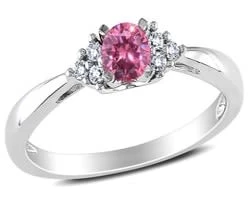
Rose gold suits pale pinks, while platinum or white gold helps stronger pinks pop. There’s no such thing as natural pink gold; rose or pink gold is an alloy with more copper and less silver, and it gives soft pinks a warm glow.
A halo of white diamonds is the classic trick: the contrast makes a small pink look brighter and bigger. Cushion and radiant cuts hold color well, which is why so many pinks are cut that way; see our guide to cushion cut engagement rings. For durability, platinum diamond rings hold small stones securely. If you shop online, retailers such as James Allen let you view stones in 360-degree video, which helps when judging color. Browse more engagement rings and Colored Rings for ideas.
How do you care for and insure a pink diamond ring?
Clean it gently with warm soapy water and a soft brush, and avoid ultrasonic cleaners or heat if the stone is treated or coated. Store it apart from other jewelry, and have the prongs checked once or twice a year.
Insure it on a scheduled policy based on a written valuation, and keep the grading report somewhere safe. Our diamond ring appraisal guide explains how to get one.
How I researched this guide
This rewrite of our original pink diamond article draws on my 20 years in the diamond trade. I checked every fact against GIA research, the National Jeweler auction report, published Argyle closure reporting and FTC guidance, and corrected older claims about manganese, the Williamson Pink and the Affleck ring.
Frequently asked questions about pink diamond engagement rings
Are pink diamonds real diamonds?
Yes. Natural pink diamonds are real diamonds colored by distortion in their crystal structure. Treated and lab-grown pinks are also real diamonds, but they must be disclosed and cost far less.
Why are pink diamonds so expensive?
They are extremely rare. Australia's Argyle mine produced over 90% of the world's pinks before closing in 2020, and strong pinks have sold for up to $5.2 million per carat at auction.
What causes the pink color in diamonds?
GIA says 99.5% of pink diamonds get their color from distortion in the crystal structure, known as plastic deformation. It is not caused by manganese, a common myth.
How much does a pink diamond engagement ring cost?
Small, pale natural pinks start around $10,000, while vivid pinks can cost hundreds of thousands per carat. Treated and lab-grown pinks, or pink accent stones, cost much less.
Is a lab-grown pink diamond a good choice?
It can be if you want the color on a budget. Lab-grown pinks are real diamonds, usually colored after growth, but they have little resale value. Make sure the report says lab-grown.
What metal looks best with a pink diamond?
Rose gold warms and deepens pale pinks, while platinum or white gold makes stronger pinks stand out. A halo of white diamonds adds contrast in either metal.
Was the Williamson Pink an engagement ring?
No. The 23.6-carat Williamson Pink was a wedding gift to Princess Elizabeth in 1947 and was set in a brooch, not an engagement ring.
Falling for pink?
Set your budget, decide between natural, treated and lab-grown, and never buy without a report. Explore more guides at Diamond Info.
Anthony Chege is a gem and jewelry dealer with 20 years’ experience sourcing, grading and selling diamonds, colored diamonds and gemstones. He writes for Diamond Rings Info on diamond grading, pricing and buying.
Diamond Info | Colored Rings |Pink Diamonds