
What should you know about heart shaped diamond rings? A heart diamond is a modified brilliant with two rounded lobes and a point, best at 0.5 carat or more with a length-to-width ratio near 1.00. It usually costs 15% to 20% less than a round of the same grade.
Last updated: November 2026 · Prices checked against graded natural and lab-grown listings
Key Takeaways
- Heart cut diamonds generally cost about 15% to 20% less than round brilliants of the same grade (International Gem Society)
- Aim for a length-to-width ratio of 0.90 to 1.10, ideally close to 1.00, so the heart looks neither squat nor stretched
- Choose at least 0.50 carat, and ideally 1 carat, because the cleft between the lobes is hard to see in small stones
- Natural 1 carat hearts were listed from $961 to $5,371 on one large price tracker (StoneAlgo)
- Lab-grown 1 carat hearts listed for $446 to $656 with IGI reports (Ritani)
- Heart diamonds hold body color near the point, so G color and SI1 clarity are sensible minimums for a white look

Diamond Rings Info may earn a commission if you buy through links on this page, at no extra cost to you.
What is a heart shaped diamond?
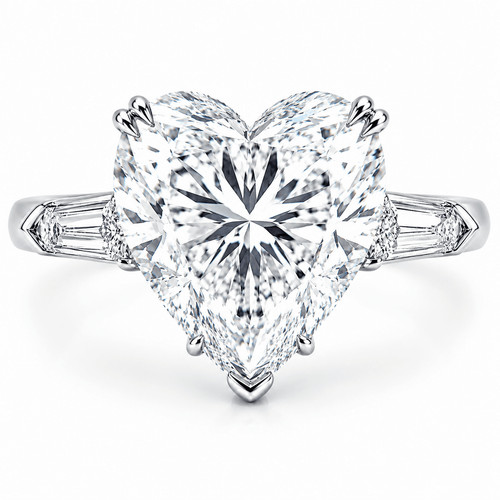
A heart shaped diamond is a brilliant-style cut with two rounded lobes, a cleft between them and a single point at the bottom. It typically has 56 to 60 facets, so it sparkles much like a round or pear shaped diamond, which is essentially a heart without the cleft.
It is one of the hardest shapes to cut well. The cutter has to keep both lobes the same size, center the cleft and line the point up with it, and any mistake shows immediately. That is why the quality of the faceting matters more here than in almost any other shape. This short video on the heart shaped cut shows the shape from every angle.
What does a heart diamond ring symbolize?
A heart diamond ring stands for romantic love and devotion, which is why it is popular for proposals, anniversaries and promise rings. The symbolism is old: the familiar heart shape came to represent love in Europe in the 15th century and spread widely in the 16th (Wikipedia: heart symbol).
Heart cut gems followed soon after. The International Gem Society traces an early heart-shaped diamond to 1463, and records that in 1562 Mary Queen of Scots sent Queen Elizabeth I a heart-shaped diamond ring as a token of friendship (International Gem Society).
Famous modern hearts include the Heart of Eternity, a 27.64 carat Fancy Vivid Blue graded by GIA and unveiled by De Beers in 2000 (Wikipedia). Because the shape carries such an obvious message, many buyers choose it for a diamond promise ring or a claddagh design, where a heart is already part of the symbol.
What proportions make a good heart shaped diamond?
A good heart has a length-to-width ratio between 0.90 and 1.10, even lobes, a crisp cleft and a point that lines up with the cleft. Within that, a ratio close to 1.00 looks the most balanced.
| Measurement | Excellent | Very good | Good |
|---|---|---|---|
| Length-to-width ratio | 0.90 to 1.10 | 0.85 to 1.15 | 0.80 to 1.20 |
| Table % | 56 to 62 | 54 to 64 | 53 to 66 |
| Depth % | 58 to 64 | 56 to 66 | 55 to 68 |
These ranges come from the Beyond4Cs heart diamond guide, and Diamonds.pro gives almost identical figures. Numbers only get you so far, though: always look at a photo or video, because two stones with the same ratio can have very different lobes. Our guide to diamond cut explains how proportions affect sparkle.
Most hearts also show a dark “bow tie” across the middle, as pears and marquise cuts do. A faint one is normal; a heavy one makes the stone look dull, so compare a few before you choose.
Which color and clarity should a heart diamond have?
Choose G color or better and SI1 clarity or better for a heart that looks white and clean. Heart diamonds tend to show body color near the point, more so than rounds, so it pays to go a little higher on color than you would for a round brilliant.
For stones over 1.5 carats, Beyond4Cs suggests F color or better, while the International Gem Society says H can still look white in smaller sizes, especially in yellow or rose gold. Clarity is easier: the brilliant faceting hides small inclusions, so an eye-clean SI1 is usually fine. Our diamond color chart and clarity chart show what each grade looks like.
Size matters more than usual too. Below about 0.50 carat the cleft is hard to see and the stone can read as a blob, and the International Gem Society recommends at least 1 carat if you want the shape to be unmistakable from across a room.
How much do heart shaped diamond rings cost?
A ring with a natural 1 carat heart diamond usually costs about $2,000 to $6,000 for the center stone, depending on color and clarity, while a lab-grown 1 carat heart can cost under $700. The setting adds to that.
| 1 carat heart diamond | Typical grade | Typical price |
|---|---|---|
| Lab-grown | G to H, SI1 to VS2, IGI report | $446 to $656 |
| Natural, budget | I to J, SI1 to SI2 | About $1,000 to $2,500 |
| Natural, mid-range | G to H, VS1 to VS2 | About $3,000 to $5,000 |
| Natural, premium | D to F, VS1 or better | About $5,000 to $6,500 |
The lab-grown figures are real IGI-graded listings at Ritani, which also listed a natural 1.10 carat D VS1 heart at $6,059. The natural tiers sit within StoneAlgo’s listed range of $961 to $5,371 for 1 carat hearts, plus that premium example; prices per carat rise steeply as stones get bigger. You can compare any grade with our diamond price calculator.
Hearts cost less than rounds of the same grade. Beyond4Cs puts the gap at 15% to 25%, and it notes that prices for similar-looking hearts can vary by as much as four times between grades, so shopping carefully pays off.

Will heart diamond prices change next year?
Natural heart prices should stay close to the ranges above for the next year or two, because fancy shapes follow the wider diamond market rather than leading it. Lab-grown prices are different: they have kept falling as production grows, so expect lab hearts to get cheaper. Before you buy, check a few current listings with the same size, grade and ratio.
Which settings suit heart shaped diamond rings best?
The best setting protects the fragile point with a V-shaped prong and holds each lobe with a round prong. A three-prong setting (two lobes and a V-tip) works for smaller stones, and Beyond4Cs suggests five prongs, including the V-tip, for larger ones.
- Solitaire: the cleanest way to show the shape, ideally with the point facing toward the fingertip.
- Halo: a frame of small diamonds that makes the heart look bigger and protects its edges.
- Bezel: a metal rim around the stone, the most secure choice for active hands.
- Three-stone: a heart center with smaller side stones, often pears or rounds.
Platinum is the strongest metal for prongs; see our guide to platinum diamond rings. Rose and yellow gold suit the romantic shape and help hide a hint of warmth in lower color grades. Hearts also look striking in fancy colors, as our pink diamond engagement rings guide shows, and in diamond necklaces and pendants.
How do you buy a heart shaped diamond?
Buy a heart diamond only after you have seen it on video or in person, checked the grading report and confirmed the ratio and symmetry. The report tells you the grades; your eyes tell you whether the lobes and point look right.
- Set a budget and decide between natural and lab-grown diamonds.
- Choose at least 0.50 carat, G color and SI1 clarity as a starting point.
- Filter for a ratio of 0.90 to 1.10, then compare the lobes, cleft and point on video.
- Insist on a GIA or IGI report and check the report number on the lab’s website.
- Pick a setting with a V-prong or bezel to protect the point.
Online retailers such as James Allen show 360-degree videos of each heart, which makes it much easier to compare symmetry. Note that Diamonds.pro warns James Allen lists the ratio the other way round (width divided by length), so a value above 1.00 there means a wider heart. For more ring ideas, browse our Engagement Rings guide.
How do you care for a heart diamond ring?
Clean it every week or two in warm water with a drop of dish soap and a soft brush, then rinse and dry. Have the prongs, especially the V-prong at the point, checked once a year, because a chipped point is the most common damage to a heart diamond.
How this guide was researched: proportions come from Beyond4Cs and Diamonds.pro, color, clarity and history from the International Gem Society, and prices from StoneAlgo’s 1 carat listings and Ritani’s natural and IGI-graded lab-grown listings.
Frequently asked questions about heart shaped diamond rings
How much does a 1 carat heart shaped diamond ring cost?
A natural 1 carat heart diamond usually costs about $2,000 to $6,000 depending on color and clarity, and a lab-grown one about $450 to $700, before the cost of the setting.
Are heart shaped diamonds cheaper than round diamonds?
Yes. Heart diamonds generally cost about 15% to 20% less than round brilliants of the same carat weight, color and clarity.
What is the best length-to-width ratio for a heart diamond?
Aim for 0.90 to 1.10, ideally close to 1.00. Lower ratios look short and wide, and higher ratios look long and narrow.
What carat size is best for a heart shaped diamond?
Choose at least 0.50 carat, and ideally 1 carat or more, because the cleft and lobes are hard to see in smaller heart diamonds.
What color grade should a heart diamond be?
G or better is a good target for a white look, because hearts show body color near the point. In yellow or rose gold, H can still look white.
What setting is best for a heart shaped diamond?
A setting with a V-prong at the point and round prongs on each lobe, or a bezel, gives the best protection. Halos add size and extra protection.
Is a heart shaped diamond good for an engagement ring?
Yes, if you love the look. It is romantic and distinctive, but it is less classic than a round or oval, so choose it for its meaning rather than resale.
Do heart shaped diamonds have a bow tie?
Most do, like pear and marquise cuts. A faint bow tie is normal, but a dark, heavy one makes the stone look dull, so compare stones on video.
Ready to choose your heart diamond?
Start at 0.50 carat or more, aim for a ratio near 1.00, choose G color and SI1 clarity or better, protect the point with a V-prong, and compare symmetry on video before you buy. For more guides, visit our Home page.
Anthony Chege is a gem and jewelry dealer with 20 years’ experience sourcing, grading and selling white and fancy color diamonds, gemstones and gold. He writes for Diamond Rings Info on diamond grading, pricing and buying.
Home | Engagement Rings | Heart Shaped Rings