
What should you know about cushion cut diamond engagement rings? A cushion is a square or rectangular diamond with rounded corners and 58 to 64 facets. Choose a ratio of 1.00 to 1.05 for a square look, and expect to pay about 20% to 30% less than for a round.
Last updated: November 2026 · Prices checked against tens of thousands of tracked online listings
Key Takeaways
- A natural 1 carat cushion had a median listing price of $2,673, against $3,710 for a 1 carat round (CaratRadar)
- A lab-grown 1 carat cushion had a median of just $516 across 17,483 listings (CaratRadar)
- Cushions generally cost 20% to 30% less than rounds of the same grade (Beyond4Cs)
- The most popular length-to-width ratio is 1.00 to 1.05, which gives a square cushion
- GIA gives cushions no cut grade, so you must judge table, depth and the facet look yourself
- The 45.52 carat Hope Diamond is an antique cushion (Wikipedia)

Diamond Rings Info may earn a commission if you buy through links on this page, at no extra cost to you.
What is a cushion cut diamond?
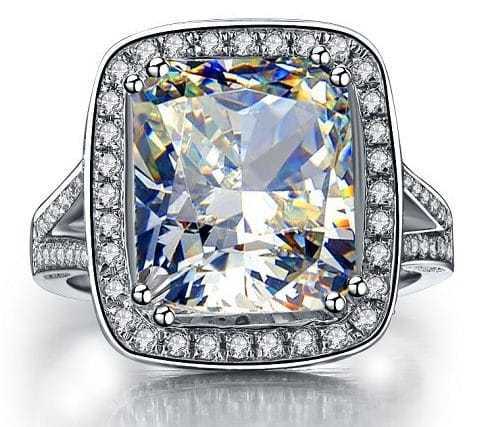
A cushion cut diamond is a square or rectangular brilliant with softly rounded corners and curved sides, so it looks like a pillow. That is why it is also called the pillow cut. It usually has 58 to 64 facets, with larger facets than a round, which gives it big flashes of light and strong fire.
A facet is one of the flat, polished planes on a diamond’s surface, and the way the facets are arranged decides how the stone sparkles. In a cushion, the open, deep pavilion also shows color more than a round does, which is worth remembering when you choose a color grade.
Where does the cushion cut come from?
The cushion grew out of the old mine cut, a squarish, hand-cut shape with chunky facets that was designed to sparkle in candlelight. Until the early 20th century the cushion was the standard diamond shape, and it only fell out of fashion when the modern round brilliant took over.
Many famous diamonds are cushions. The deep blue Hope Diamond, now in the Smithsonian, weighs 45.52 carats and is described as an antique cushion with extra facets on the pavilion (Wikipedia).
Today’s cushions are far more symmetrical than antique ones thanks to modern lapidary or cutting methods and better equipment. If you love the original look, antique and vintage diamond engagement rings often feature old mine cushions.
What is the difference between a cushion brilliant and a “crushed ice” cushion?
A cushion brilliant has broad, chunky facets that create bold flashes, while a cushion modified brilliant has an extra row of pavilion facets that create a busy, sparkly “crushed ice” look. Both are graded simply as “cushion” or “cushion modified brilliant”, and nothing on a certificate shows which look you are getting.
| Style | Facet look | Best for |
|---|---|---|
| Cushion brilliant | Large, chunky facets with bold flashes | Classic and antique styles |
| Cushion modified brilliant | Many small facets, crushed ice sparkle | Maximum glitter, hiding inclusions |
| Old mine cut | Hand-cut, high crown, small table, open culet | Antique and vintage lovers |
The only way to tell them apart is to look at a photo or video of the actual stone. Neither is better; it is a matter of taste, though crushed ice cushions can look slightly hazy when the stone is large.
What proportions make a good cushion cut diamond?
A good square cushion has a length-to-width ratio of 1.00 to 1.05, a table of 60% to 65% and a depth of 65% to 69%. Elongated cushions are popular too, but stretched cushions tend to leak more light.
| Measurement | Excellent | Very good | Good |
|---|---|---|---|
| Length-to-width ratio | 1.00 to 1.05 | 1.06 to 1.20 | 1.21 to 1.35 |
| Table % | 60 to 65 | 57 to 68 | 55 to 70 |
| Depth % | 65 to 69 | 62 to 71 | 59 to 73 |
These guidelines come from Beyond4Cs, because GIA does not give cushions a cut grade. That makes the polish and symmetry grades, plus your own eyes, more important. If you prefer a longer stone, compare it with an oval engagement ring or an emerald cut engagement ring.
Which color and clarity are best for a cushion?
G color or better and SI1 clarity or better are good targets for a white cushion. Most buyers choose G, H or I, and in yellow or rose gold a J or K can look pleasantly warm.
Clarity is forgiving. In a well-cut cushion, most VS2 and SI1 stones are eye-clean, especially in the crushed ice style, which hides small inclusions. Check the stone on video and avoid dark inclusions under the table. Our diamond color chart and clarity chart explain each grade.
Cushions are also popular for fancy color diamonds: in a GIA study of yellow and orange diamonds, a third were cut as cushions, because the deep pavilion intensifies color. See our guide to yellow diamond engagement rings for examples.
How much do cushion cut diamond engagement rings cost?
A natural 1 carat cushion usually costs about $1,750 to $6,200 for the center stone, with a median around $2,700. A lab-grown 1 carat cushion usually costs about $330 to $1,400, with a median around $500.
| Loose cushion diamond | Median price | Most listings |
|---|---|---|
| 1 carat, lab-grown | $516 | $334 to $1,413 |
| 1 carat, natural | $2,673 | $1,755 to $6,172 |
| 2 carat, lab-grown | $1,061 | Average $1,458 |
| 2 carat, natural | $12,844 | $6,990 to $24,841 |
These are medians of thousands of listings at major online stores tracked by CaratRadar for the 2 carat natural and 2 carat lab-grown cushions as well as the 1 carat stones. The same tracker put the median natural 1 carat round at $3,710, so the cushion was about 28% cheaper.
Add the setting on top: a simple solitaire costs much less than a pavé halo. To estimate other grades and sizes, try our diamond price calculator, or read about lab-grown diamonds if budget is the priority.

Will cushion diamond prices change next year?
Natural cushion prices should stay close to these ranges, though they have been drifting slightly lower; CaratRadar recorded a 1.6% fall in the average 1 carat price over one month. Lab-grown prices are falling faster, with a 6.6% drop over the same month, so expect lab cushions to keep getting cheaper. Check current listings before you buy.
Which settings suit a cushion cut diamond?
The cushion is one of the most versatile shapes. A four-prong solitaire shows off its outline, and a pavé halo makes it look larger, which is why the halo is the classic cushion engagement ring.
- Solitaire: four prongs, or double claws on each corner for extra security.
- Halo: a frame of small diamonds that adds size and sparkle. Check that a thick girdle does not make the stone sit too tall.
- Three-stone: a cushion center with smaller cushions, rounds or heart shaped diamonds at the sides.
- Split shank and pavé bands: a more complex design that adds sparkle along the band.
Platinum is the most durable choice for prongs, as our platinum diamond rings guide explains, while 14K white gold costs less. Yellow and rose gold suit antique-style cushions and warmer color grades.
How do you choose a cushion cut diamond ring?
Choose a cushion by looking at it, not just its report: decide between the chunky and crushed ice look, then check the ratio, table, depth and color in a video.
- Pick natural or lab-grown and set a budget.
- Decide on a square (1.00 to 1.05) or elongated (up to about 1.20) outline.
- Filter for table 60% to 65%, depth 65% to 69%, G color and SI1 clarity or better.
- Watch the 360-degree video to judge the facet pattern and look for dark areas.
- Insist on a GIA or IGI report and check the number online.
Online sellers such as James Allen show high-resolution videos of every cushion, which is the easiest way to tell a chunky stone from a crushed ice one. If a cushion is not for you, our Princess Cut Rings guide covers the closest square alternative, with sharp corners.
How this guide was researched: proportions, color and clarity guidance come from Beyond4Cs, prices from CaratRadar’s tracked listings of natural and lab-grown cushions at major online stores, and history from the Hope Diamond’s documented record.
Frequently asked questions about cushion cut diamond engagement rings
How much does a 1 carat cushion cut engagement ring cost?
A natural 1 carat cushion diamond usually costs about $1,750 to $6,200, with a median around $2,700, and a lab-grown one about $330 to $1,400, before the setting.
Are cushion cut diamonds cheaper than round diamonds?
Yes. Cushions generally cost about 20% to 30% less than rounds of the same grade. In one large listing sample, the median natural 1 carat cushion cost about 28% less than a 1 carat round.
What is the best ratio for a cushion cut diamond?
For a square cushion, aim for 1.00 to 1.05. Elongated cushions usually run from about 1.10 to 1.20, but very long cushions tend to leak light.
What is a crushed ice cushion?
A crushed ice cushion is a cushion modified brilliant with an extra row of pavilion facets, which creates a busy, glittery sparkle instead of the bold flashes of a classic cushion brilliant.
What color grade is best for a cushion cut diamond?
G or better gives a white look in platinum or white gold. Many buyers choose G to I, and J or K can look attractively warm in yellow or rose gold.
Does GIA give cushion cut diamonds a cut grade?
No. GIA grades cut only for round brilliants, so for cushions you need to check the table, depth, polish and symmetry and look at the stone on video.
Are cushion cut diamonds out of style?
No. The cushion was the standard shape until the early 20th century, and its soft, vintage look keeps it popular, especially in halo and antique-style settings.
Is a cushion or princess cut better?
A cushion has rounded corners, larger facets and a softer, vintage look, while a princess has sharp corners and a crisp, modern look. Cushions are less prone to chipping at the corners.
Ready to choose your cushion diamond?
Decide on the chunky or crushed ice look, aim for a ratio of 1.00 to 1.05 for a square stone, choose G color and SI1 clarity or better, and compare stones on video before you buy. For more guides, visit Diamond Info.
Anthony Chege is a gem and jewelry dealer with 20 years’ experience sourcing, grading and selling white and fancy color diamonds, gemstones and gold. He writes for Diamond Rings Info on diamond grading, pricing and buying.
Diamond Info | Princess Cut Rings | Cushion Cut Rings