
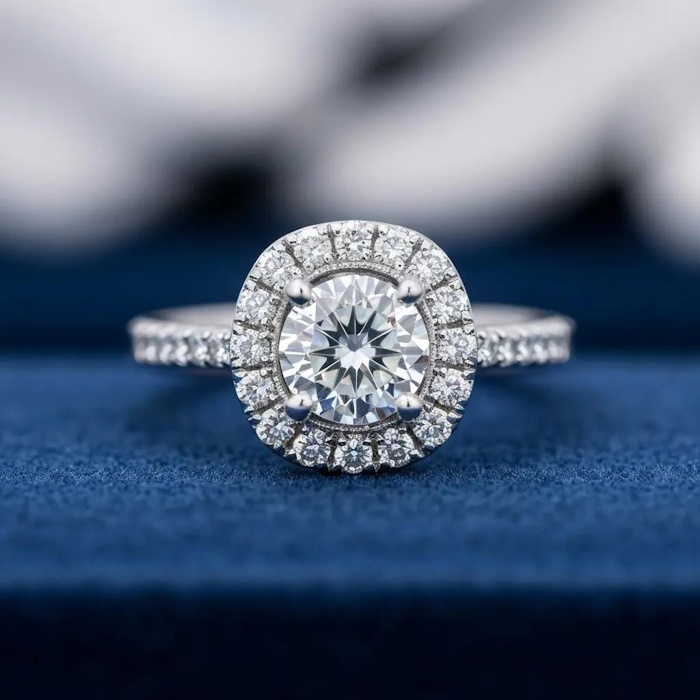
How much does a 4 carat diamond ring cost? About $62,000 for a natural center stone and about $2,000 for a lab-grown one in October 2026 — a roughly 30-fold gap for stones of the same weight, before the setting.
A 4 carat diamond ring is more than double the size most couples buy, so the details matter. This guide covers real prices, how big the stone looks, which of the 4Cs deserve your money and how to buy safely. For wider background, see our diamond rings guide.
Key Takeaways
- The median 4 carat natural diamond lists at $62,384; a lab-grown one at $2,058 (CaratRadar, Oct 2026).
- A 4 carat stone weighs 800 mg and a round measures about 10 mm across (Vrai).
- The average US engagement stone is 1.9 carats, so 4 carats is about double the norm (The Knot via IDEX).
- Start from G color and VS2 clarity: bigger stones show color and inclusions more readily.
- Lab-grown made up 61% of US engagement ring center stones in 2025, so it is now the mainstream choice.
- Only buy with a GIA or IGI report, and compare the same certificate across sellers.
How much does a 4 carat diamond ring cost?
For the loose stone, the median asking price in the 4.00-4.49 carat band is $62,384 for natural and $2,058 for lab-grown, across all shapes. Those figures come from 2,462 natural listings and 43,532 lab-grown listings tracked in mid-to-late October 2026.
| 4.00-4.49 ct, all shapes, Oct 2026 | Natural | Lab-grown |
|---|---|---|
| Listings tracked | 2,462 (12 retailers) | 43,532 (19 retailers) |
| Lowest listing | $321 | $131 |
| Median | $62,384 | $2,058 |
| Average | $66,291 | $2,959 |
| Highest listing | $472,362 | $283,940 |
Asking prices for the loose stone only. The very low listings are poor-quality stones, and the highest are top-grade or fancy-color material, so use the median as your benchmark.
A finished ring costs more. Brilliant Earth’s guide, which assumes a basic $650 solitaire setting, puts a natural 4 carat ring at $20,150 to $136,650 and a lab-grown one at $3,650 to $45,150, before tax, insurance and engraving.
How does the price compare with a 2 carat ring?
Doubling the weight roughly quadruples the price for natural stones. The median 4 carat round natural diamond lists at $62,020, against a $15,580 median for a 2 carat round when we checked on 2 October. For lab-grown rounds the step is small: a 4 carat averages $1,749 versus $1,398 for a 2 carat, about 25% more.
Should your 4 carat diamond ring be natural or lab-grown?
Choose lab-grown if you want the most size and quality per dollar, and natural if rarity and resale matter more to you. Both are real diamonds, and the FTC requires sellers to qualify a lab stone with terms such as laboratory-grown rather than selling it as “natural” or “genuine”.
The market has already moved. The Knot’s survey of about 10,500 couples found 61% chose a lab-grown center stone in 2025, up from 52% in 2024, and lab-grown buyers averaged a 2.0 carat stone. At 4 carats, the lab-grown price gap is the strongest argument for that choice.
What is the trade-off?
Resale and rarity. Natural 4 carat stones are far scarcer, and their prices moved only 1-2% last month, while lab-grown prices fell about 17% over six months in CaratRadar’s index. Treat either as a ring to wear, not a financial investment.
How big does a 4 carat diamond ring look?
A 4 carat round brilliant measures about 10 mm across, and the stone weighs 800 mg. Brilliant Earth lists the round at about 10.2 mm, so expect 10.0 to 10.2 mm for a well-cut stone.
Drawn to scale at 14 px per mm. Diameters for 1-3 carats from Washington Diamond; 4 carat from Vrai.
Shape changes how large the stone appears. Elongated cuts spread the weight over a longer outline, so a 4 carat marquise or oval looks bigger than a round, while a cushion looks smaller.
| 4 carat shape | Typical size | Notes |
|---|---|---|
| Round | 10.0-10.2 mm | Maximum sparkle, compact outline |
| Oval | 11 x 9 to 13 x 9 mm | Sources differ by length-to-width ratio |
| Emerald | about 10.6-10.7 x 7.5-7.9 mm | Shows color and inclusions readily |
| Cushion | about 9.25 mm | Looks smaller than a round |
| Marquise | about 16.5 x 8.25 mm | Largest face-up, elongates the finger |
Sizes from Vrai and Brilliant Earth.
Which 4Cs matter most in a 4 carat diamond ring?
Put cut first, then color, then clarity. GIA grades cut on a five-point scale from Excellent to Poor for round brilliants only, so look for Excellent, or at least Very Good, which Brilliant Earth gives as its minimum.
| The C | Sensible target at 4 carats | Why |
|---|---|---|
| Cut | Excellent (round) | Drives sparkle and how large the stone looks |
| Color | G or better | Larger stones show more body color |
| Clarity | VS2 or better, eye-clean | Inclusions are easier to see in a big stone |
| Carat | 4.00-4.49 ct band | Compare 3.9x ct stones to save money |
Why do color and clarity matter more at this size?
Larger diamonds show more color, and step cuts such as emerald and Asscher show it most, so G or higher is the safer choice. Imperfections follow the same rule: one jeweler notes that the larger the diamond, the more visible any imperfections may become.
You can still save money. CaratRadar notes that moving down one clarity grade, such as VS2 to SI1, may save 10-15% with no visible difference, but at 4 carats you should confirm the stone is eye-clean on video first.
What setting suits a 4 carat diamond ring?
Choose a secure setting, because 800 mg of stone sits high on the finger. Vrai recommends a six-prong, cathedral or bezel setting to hold the stone firmly and keep it from snagging.
Thin bands make the stone look larger, while a halo adds sparkle but also cost. If the stone is an emerald cut, remember the setting cannot hide inclusions or color the way it can on a brilliant cut.
How do you buy a 4 carat diamond ring safely?
Follow this checklist before paying for any 4 carat stone:
- Require a GIA or IGI report and match the report number to the stone. Reports on lab-grown stones state the origin, and GIA and IGI inscribe it on the girdle.
- Compare the exact same certificate across sellers, because identical-grade stones list at very different prices.
- Treat a price far below the median as a warning and check the seller’s reputation and return policy first.
- Ask for high-resolution video of the actual stone and judge sparkle and eye-cleanliness yourself.
- Get grades, return window and insurance terms in writing before you pay.
What do buyers ask about a 4 carat diamond ring?
How much does a 4 carat diamond ring cost?
The median stone price in October 2026 was $62,384 for natural and $2,058 for lab-grown, across all shapes in the 4.00-4.49 carat band. The setting costs extra.
How big is a 4 carat diamond?
It weighs 800 milligrams. A round measures about 10 to 10.2 mm across, and elongated shapes such as oval, marquise and pear look larger face-up.
Is a lab-grown 4 carat diamond a real diamond?
Yes. It has the same chemistry as a mined diamond. Sellers must disclose that it is lab-grown.
What color and clarity should a 4 carat diamond have?
G or better in color and VS2 or better in clarity is a common target. Larger stones show color and inclusions more easily, so check the actual stone.
Is a 4 carat diamond ring a good investment?
Treat it as a ring to wear. Natural stones tend to hold value better than lab-grown, but asking prices are not resale prices.
Which setting is best for a 4 carat diamond ring?
A six-prong, cathedral or bezel setting holds a heavy stone securely and snags less.
Which certificate should a 4 carat diamond have?
GIA or IGI. An independent report states the weight and the color, clarity and cut grades, so you are not relying on the seller’s word.
Methodology. Prices come from CaratRadar listing data for the 4.00-4.49 carat band, retrieved 17-23 October 2026 (2,462 natural and 43,532 lab-grown listings across all shapes; 888 natural round listings). The 2 carat comparison uses CaratRadar data retrieved 1-2 October 2026. Sizes come from retailer guides by Vrai and Brilliant Earth, and market-share figures from The Knot’s 2026 Real Weddings Study as reported by IDEX. Because a ring purchase is a major financial decision, no Reddit or forum anecdotes were used. Prices are asking prices, not sale prices, and change daily.