
What is a marquise diamond ring? A marquise diamond ring is set with a long, boat-shaped brilliant-cut diamond with two pointed ends. It looks larger than a round of the same carat weight, but the points need protecting and a good cut keeps the dark bow-tie to a minimum.
Last updated: November 2026 · Checked against GIA buying guidance and The Knot’s engagement ring data
Key Takeaways
- 8% of engagement rings bought in 2025 had a marquise center stone, level with emerald, princess and pear, behind round (26%) and oval (25%) (Rapaport)
- The shape is also called the navette, French for “little boat” (Wikipedia)
- Legend says Louis XV had it cut to resemble the mouth of Madame de Pompadour, who became a marquise in 1745 (Wikipedia)
- GIA gives cut grades only to round brilliants, so judge a marquise on symmetry, polish and the bow-tie (GIA)
- A length-to-width ratio of roughly 1.75 to 2.25 gives the classic look; about 2:1 is the traditional ideal
- The two points are the weakest spots, so choose V-prongs or a bezel that covers them

What is a marquise diamond ring?
It holds a diamond cut into a long ellipse with a point at each end, a shape also called the navette, French for “little boat” (Wikipedia). It’s a modified brilliant, so it uses a facet pattern adapted from the round brilliant, which has 58 facets including the culet.

Cutters choose the shape when a rough diamond is long and flat, because a marquise keeps more of that crystal’s weight than a round would. The quality of the cut then decides how bright the finished stone looks. You can see the shape in motion in this short video of a marquise diamond.
Where does the marquise shape come from?
The popular story is French. According to legend, Louis XV commissioned the cut to resemble the mouth of Madame de Pompadour, his official chief mistress from 1745 to 1751, who had been made a marquise in 1745 (Wikipedia). That’s where the name comes from.
Two corrections to the version you’ll often read: the king was Louis XV, not Louis XIV, and the tale is a legend rather than a documented commission. Either way, the shape’s long elegant line has kept it in fashion for centuries.
Does a marquise diamond ring look bigger?
Yes. For its weight, a marquise has one of the largest face-up areas of any diamond shape, because its length spreads the carats across a long outline. That makes it look bigger than a round of the same carat weight, and it makes fingers look longer and slimmer.

The stone is spread out and relatively shallow for its length, which is why it reads so large. If you like the elongated look but want softer ends, compare pear shaped diamonds. or the straight lines of an emerald cut.
How do you judge marquise diamond quality?
Judge a marquise on symmetry, the bow-tie and its proportions before color and clarity. GIA does not give fancy shapes a cut grade, so look at the polish and symmetry grades on the report and at the stone itself (GIA).
| Factor | What to look for | Why it matters |
|---|---|---|
| Symmetry | Both curved sides match; points line up with the center | A lopsided marquise is obvious on the finger |
| Length-to-width ratio | About 1.75 to 2.25; near 2:1 is classic | Lower looks stubby, higher looks very thin |
| Bow-tie | A faint dark band across the middle, not a black stripe | Well-cut stones keep it subtle |
| Clarity | Eye-clean; often VS2 or better near the points | Inclusions at the tips can weaken them |
| Color | G to H in white metal; I or J can work in yellow gold | Color gathers at the points of long shapes |
Every marquise shows some bow-tie, the dark band caused by light leaking through the middle of an elongated stone, and the same happens in pears and ovals. The goal is a soft one, so view the stone in person or on video. Use our clarity chart and color chart to compare grades, and buy with an independent report; our diamond certificate guide shows what to check.

Which settings protect marquise diamond rings best?
V-prongs or a bezel at both points give the best protection, because the sharp tips are the most likely place to chip. Most settings use six prongs: one V-shaped prong over each point and two along each side to hold the long body.
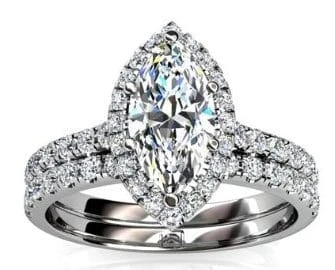
A plain four-prong setting that doesn’t cover the tips leaves them exposed, so ask for V-prongs. A halo of small diamonds also guards the edges and adds sparkle, and a three-stone ring with marquise or round side stones is a popular vintage look. Our guide to diamond ring settings compares the options.
Most marquise rings run the stone along the finger, but an east-west setting turns it across the band for a modern twist, and vintage rings often cluster small marquises into flower or starburst shapes. Strong metals help: platinum holds V-prongs especially well.
Are marquise diamond rings popular?
Yes, and their popularity has been steady rather than falling. In The Knot’s study of couples married in 2025, 8% of engagement rings had a marquise center stone, the same share as emerald, princess and pear cuts (Rapaport).
Round and oval still lead, at 26% and 25%, so a marquise stands out without being unusual. It also pairs well with curved or contour wedding bands; our diamond wedding ring sets guide shows how to match them.
How much do marquise diamonds cost?
Marquise diamonds usually cost less per carat than round brilliants of similar grades, because cutting them saves more of the rough crystal. Combined with their large face-up size, that makes the marquise one of the best-value shapes for looking bigger.
Spend the savings on symmetry and a well-controlled bow-tie rather than top color or clarity. Lab-grown marquises cost far less again if size matters most. For a different square look, compare our Princess Cut Rings guide.
How do you care for a marquise ring?
Clean it with warm water, mild dish soap and a soft brush, and have a jeweler check the V-prongs at both points once or twice a year. Take the ring off for the gym, gardening and heavy work, because a hard knock on a point can chip it.
How I researched this guide
This rewrite draws on my 20 years grading and setting fancy-shape diamonds. Facts come from GIA’s fancy-shape buying guidance, The Knot’s study of 10,000+ couples via Rapaport, and published references on the marquise cut and Madame de Pompadour. The ratio and grade ranges are trade rules of thumb.
Frequently asked questions about marquise diamond rings
What is a marquise cut diamond?
A marquise is a long, boat-shaped modified brilliant cut with two pointed ends, also called the navette. It adapts the round brilliant’s facet pattern to an elongated outline.
Why is it called a marquise?
Legend says Louis XV had the cut made to resemble the mouth of Madame de Pompadour, who became a marquise in 1745. The story is a legend rather than a documented commission.
Does a marquise diamond look bigger than a round?
Yes. Its long outline spreads the weight over a larger face-up area, so a marquise usually looks bigger than a round of the same carat weight and makes fingers look slimmer.
What is the best length-to-width ratio for a marquise?
Roughly 1.75 to 2.25, with about 2:1 the traditional ideal. Below that the stone looks stubby and above it the stone looks very thin.
What is the bow-tie effect in a marquise diamond?
It is a dark band across the middle of an elongated diamond caused by light leaking out. Every marquise shows some bow-tie; a well-cut stone keeps it faint.
What setting is best for a marquise diamond ring?
V-prongs or a bezel over both points, usually with six prongs in total. The points are the most fragile part of the stone and need protecting.
Are marquise diamonds cheaper than round diamonds?
Usually, per carat, because cutting them saves more rough. Combined with their large face-up size, that makes them good value for looking bigger.
Are marquise engagement rings still popular?
Yes. In The Knot’s study of couples married in 2025, 8% of engagement rings had a marquise center stone, the same share as emerald, princess and pear cuts.
Ready to find your marquise?
Check symmetry and the bow-tie, protect the points with V-prongs, and explore more ring guides at Diamond Info.
Anthony Chege is a gem and jewelry dealer with 20 years’ experience sourcing, grading and selling diamonds and gemstones. He writes for Diamond Rings Info on diamond grading, pricing and buying.
Diamond Info | Princess Cut Rings | Marquise Rings