
What are diamond earrings? Diamond earrings are earrings set with natural or lab-grown diamonds — studs, hoops, huggies, drops and more — worn through a pierced earlobe or cartilage, or with clip-on and magnetic backs for unpierced ears.
Last updated: October 2026 · Piercing facts checked against Cleveland Clinic and peer-reviewed research
Key Takeaways
- People have worn gold earrings for roughly 4,500 years — examples were found in Queen Puabi’s tomb at Ur (c. 2600–2500 BCE) — Earring history
- Earlobe piercings typically heal in 6–8 weeks; cartilage piercings take 6–12 months — Cleveland Clinic
- In a 15-year study of 1,085 patients, 81.3% of those with past earring inflammation had a metal allergy, vs 60.4% without — Scientific Reports, 2025
- The Association of Professional Piercers says piercing guns are “NEVER appropriate” — single-use needles are the professional standard
- GIA suggests diamond studs of 0.50 ct or more per earring, with both stones matched on the 4Cs — GIA
- Screw backs and locking backs are the most secure options for valuable studs; friction (push) backs are the easiest to lose

What are diamond earrings?
Like all other earrings, these attach to the ear mainly through a piercing in the earlobe or another part of the outer ear. The one big exception is non-pierced styles such as clip-on earrings, which grip the lobe instead.

Unlike toe rings, earrings were traditionally worn mostly by women, but today both sexes wear them in most parts of the world. Male actors and musicians have a particular liking for diamond studs, which made a single stud or a matched pair a mainstream men’s accessory.
The diamonds themselves can be mined or lab-grown; both are real diamonds. If you are weighing the two, our guide to lab-created vs real diamonds explains the price and resale differences.
How old is the tradition of wearing earrings?
Ear piercing is one of the oldest forms of body decoration. Gold earrings have been excavated from Queen Puabi’s tomb in the Royal Cemetery at Ur, dated to around 2600–2500 BCE, and from Lothal in India (Wikipedia: Earring).
Men wore them too. Carved images of Persian soldiers wearing earrings line the palace walls of Persepolis in ancient Persia. In the West, ear piercing spread among men from the late 1960s, and by the early 21st century it was widely accepted for men to pierce one or both ears.
Earrings are usually easy to remove, but some are designed to be permanent. Permanent ear-boring was once used as a mark of servitude — the Book of Exodus (21:6) describes it as a sign of lifelong service.
Do you need pierced ears to wear diamond earrings?
For most diamond earrings, yes — your ears will need to be pierced. Standard ear piercing means the earlobe, while piercing the upper ear is called cartilage piercing. Clip-on, magnetic and screw styles are the alternatives for unpierced ears (covered below).
Cartilage piercings are more complex to perform and take much longer to heal. Cleveland Clinic gives 6–8 weeks for earlobes and 6–12 months for cartilage such as the helix, tragus, rook, daith and conch, because cartilage has a poorer blood supply (Cleveland Clinic).
Piercing gun or piercing needle?
Ear piercing guns are the most common way to pierce ears in shops, with the Studex75 (System 75) and the Inverness system the best-known brands. Both modern systems use single-use, sealed, pre-sterilized cartridges so the operator never touches the stud (Wikipedia: Ear piercing instrument). Inverness markets its fully enclosed capsules as a contamination barrier.
The gun body itself is reused on many customers, so it must be cleaned between uses — older spring-loaded designs cannot easily be sterilized at all. That is the main infection risk with guns.
A hollow piercing needle, used by professional body piercers, is the safer and usually less painful method. It removes a tiny core of tissue and leaves a clean channel (fistula) that heals better than the hole made when a gun forces a blunter stud through the lobe. The needle is thrown away immediately after use.
Professional bodies are blunt about it. The Association of Professional Piercers states that “piercing guns are NEVER appropriate, and are often dangerous when used on anything—including earlobes” (APP). Family physician Dr. Shannon Thompson of Cleveland Clinic also recommends needles over guns, especially for children.
Which metals are safest for new piercings?
Choose 14K gold, titanium or medical-grade steel posts, and avoid nickel-containing costume metals. Nickel is the most common cause of earring reactions: the 2025 Tokushima University study above linked earring inflammation to significantly higher metal-allergy rates (p < 0.001).
The EU has limited nickel release from posts inserted into pierced ears to 0.2 µg/cm² per week since 1994, now enforced under REACH Annex XVII (Nickel Directive). Platinum and higher-karat gold are good choices for sensitive ears once the piercing has healed.
How should you care for a new piercing?
Clean the piercing twice a day with antibacterial soap and water, wash your hands before touching it, and keep the earring back secure but not tight. Cleveland Clinic advises against twisting the stud and against antibiotic creams and tea tree oil, which “don’t help you heal any faster.” See a doctor if redness, swelling, pus or pain persists.
What types of diamond earrings are there?
The main styles are studs, hoops, huggies, sleepers, dangles and drops, ear screws, slave (Bajoran) earrings, ear cuffs, ear hooks and spring hoops. Diamonds can be set in any of them.
Stud diamond earrings
A stud is a diamond mounted on the end of a post, held in place by a removable clutch or back. A screw back is normally used to secure expensive studs. Studs are the everyday classic: they suit every face shape and are the easiest style to wear with anything.
Hoop diamond earrings
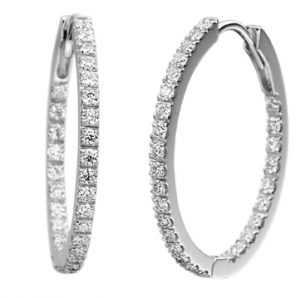
Hoops are circular or semicircular and look a lot like rings. They are often made from tubing with a thin wire attached that passes through the lobe, and the whole piece is held by tension between wire and tube. Diamond hoops are usually pavé- or channel-set along the front face.
Sleeper earrings
A sleeper is a special type of hoop worn at night to keep a piercing from closing. It is made from a very small continuous piece of gold wire that lies snugly at the base of the lobe, with the ends meeting at the back.
Huggie diamond earrings
Huggies are small, thick hoops whose setting literally hugs your earlobe instead of dangling. They are very popular for second and third lobe piercings and for anyone who wants sparkle that won’t snag on clothing.

Ear screws
Ear screws are screwed onto the lobe and allow exact adjustment, making them an alternative for people who find clips too painful. Many custom jewelers like them because of the variety of settings available; the channel setting is especially popular with this design.
Slave (Bajoran) earrings
The slave earring is also called a Bajoran earring, a name it gained after appearing on Star Trek. It is a rarely seen style in which a stud is connected by a delicate chain to an ear cuff or to a cartilage piercing higher on the ear. With small diamonds along the chain, they make striking statement earrings.
Dangle and drop diamond earrings
Dangle earrings are designed to flow from the bottom of the earlobe. They come in lengths from about a centimetre all the way to brushing the shoulders. Most attach with thin wires that pass through the lobe and hook back on themselves, or with a hinged lever-back for extra security.

Ear hooks and spring hoops
An ear hook is a large hook, shaped like a fish hook, that hangs over the whole ear and dangles. Spring hoops look almost identical to standard hoops but stay in place by spring force.
How do the earring styles compare?
| Style | Piercing needed? | Best for | Security |
|---|---|---|---|
| Studs | Lobe or cartilage | Everyday wear, first diamond purchase | High with screw or locking backs |
| Hoops | Lobe | Day-to-evening versatility | Medium–high (hinged closures best) |
| Huggies | Lobe or cartilage | Stacking multiple piercings | High — close fit, little snagging |
| Sleepers | Lobe | Keeping a piercing open overnight | High |
| Dangles / drops | Lobe | Evening wear, elongating the neck | Lower on open hooks; good with lever-backs |
| Slave (Bajoran) | Lobe + cartilage or cuff | Statement looks | Medium — chain can snag |
| Clip-on / ear screw | No | Unpierced ears | Medium; screws adjust precisely |
What are the options for unpierced ears?
If you don’t want a piercing, you can still wear diamonds with clip-ons, ear screws, ear cuffs or magnetic backs. Each grips the ear without passing through it.
- Clip-on earrings have existed longer than any other non-pierced variety. The clip is a two-part piece on the back of the earring that closes around the lobe, using mechanical pressure to hold it in place.
- Ear cuffs are curved bands of metal pressed onto the helix (outer rim) of the ear. They stay on by gently pinching the ear.
- Magnetic earrings mimic the look of a pierced stud by attaching to the lobe with a magnetic back.
- Stick-on earrings are adhesive-backed pieces that stick to the skin of the lobe. They are considered a novelty item and are rarely used for real diamonds.
The same idea applies to other body jewelry: our guides to belly button rings and diamond nose rings cover non-ear piercings.
Which diamond earring backs are most secure?
Screw backs and locking backs are the most secure choices for valuable pieces; friction (push) backs are the most common but the easiest to lose. GIA’s stud guide ranks them the same way (GIA).
If you already own studs on push backs, a jeweler can usually swap them for screw or locking backs on the same post in minutes, as long as the post is threaded or compatible.
How do you choose diamond earrings?
Choose a pair by matching the two stones on the 4Cs, picking the total carat weight that suits your budget, and pairing a secure setting with a metal that suits your skin. Remember that you are buying two diamonds, not one.
Carat weight. Earrings are sold by total carat weight (ct tw), so “1 ct tw” studs are two stones of about 0.50 ct each. GIA notes you can save by buying just under key weights such as 0.50, 0.75 and 1.00 ct. Our diamond carat guide shows the size of each weight.
Color and clarity. Because earrings are seen from a distance, you can go lower on both than for a ring. GIA says SI1, SI2 or even I1 clarity gives good value in studs, and lower color grades work well, especially in yellow gold. Compare grades in our clarity chart and color chart.
Cut and shape. Cut matters most for sparkle: GIA warns “a poorly cut diamond won’t have much brightness, fire or scintillation.” Round brilliants are the most popular shape, and princess cuts give a crisp square look.
Setting. Three- or four-prong settings show the most diamond and sparkle; a bezel wraps metal around the edge for maximum security — see our bezel setting guide. Always ask for a grading report on larger stones; our diamond certificate guide explains what to check.
Men’s studs follow the same rules, usually in heavier bezel or flush settings; see our men’s diamond rings guide for matching pieces.

How do you clean and care for diamond earrings?
Soak them in warm water with a little mild dish soap, brush gently behind the stone with a soft toothbrush, rinse and pat dry. Clean studs regularly, because skin oils and lotion on the back of the diamond quickly dull its sparkle.
Check that posts are straight and backs grip firmly every few months, and have prongs inspected yearly. Avoid home ultrasonic cleaners on pavé or channel-set earrings, as vibration can loosen small stones — read our ultrasonic jewelry cleaner guide first. Store each pair separately so diamonds don’t scratch other jewelry.
How we researched this guide
This guide updates our 2013 article using Anthony Chege’s 20 years in the gem and jewellery trade. Facts come from Cleveland Clinic, GIA, the Association of Professional Piercers, a 2025 study of 1,085 patients and De Beers research. It is general information, not medical advice — see a doctor or professional piercer about any reaction or infection.
Frequently asked questions about diamond earrings
What is the most popular style of diamond earrings?
Diamond studs are the most popular style because they suit every face shape and outfit. Round brilliant studs are the classic choice, with princess-cut studs a popular square alternative.
What does 1 carat total weight mean for earrings?
Total carat weight (ct tw) is the combined weight of both diamonds. A pair of 1 ct tw studs is two stones of roughly 0.50 carat each.
Is a piercing gun or a needle better for ears?
A single-use hollow needle is generally considered safer. The Association of Professional Piercers says piercing guns are never appropriate, and Cleveland Clinic physicians recommend needles, especially for children.
How long before I can wear diamond earrings after a piercing?
Wait until the piercing has healed: typically 6–8 weeks for earlobes and 6–12 months for cartilage, according to Cleveland Clinic. Keep the starter studs in until then.
Can I wear diamond earrings if my ears aren’t pierced?
Yes. Clip-on earrings, ear screws, ear cuffs and magnetic backs all hold diamond earrings without a piercing. Clip-ons and screws are the most practical for real diamonds.
Which earring back is most secure for diamond studs?
Screw backs and locking backs such as La Pousette are the most secure. Friction push backs are the most common but are the easiest to lose.
Are diamond earrings safe for sensitive ears?
The diamond itself won’t cause a reaction; the metal can. Choose posts in 14K gold or higher, platinum or titanium, and avoid nickel-containing costume metals.
What clarity should I choose for diamond earrings?
Because earrings are viewed from a distance, GIA says SI1, SI2 or even I1 clarity can offer good value in studs, as inclusions are rarely visible without magnification.
Find the right pair
Whatever style takes your fancy, make sure your earrings have real diamonds in them. Estimate what a pair should cost with our diamond price calculator, or browse more guides on the Diamond Rings Info home page.
Anthony Chege is a gem and jewellery dealer with 20 years’ experience sourcing, grading and selling diamonds and coloured gemstones. He writes for Diamond Rings Info on diamond grading, pricing and buying.
Home | Belly Button Rings | Diamond Earrings
I found this website while I was browsing for cartilage jewelry
and I think that I am very fortunate for doing this.
I believe that this is an extremely impressive post you have here.
Would you mind if I liked your site on twitter along with the url and header
of your post:”Diamond Ear Rings – Let your lobes get noticed; wear gems in them”
Kisses!!
Cartilageearring.net